Reasons for a Power Grid
If self-sufficiency through solar power is the cheapest option, then the only remaining motivation is to utilize surplus energy—for example, for a central power-to-methanol plant.
A century ago, when the political rallying cry everywhere was “Electricity to even the remotest mountain farming village,” there was a clear motive: to halt rural exodus, and decentralized power generation was extremely inefficient at the time.
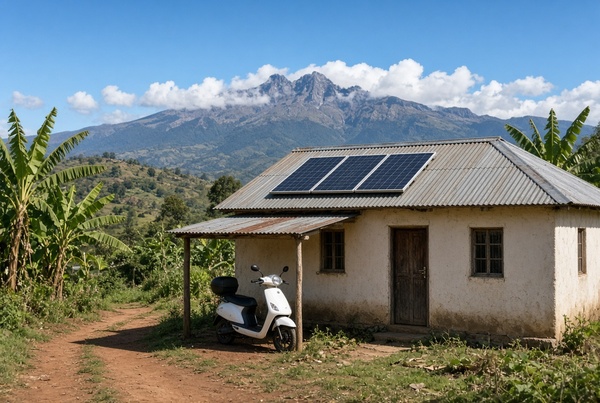 The image is from the PEGE energy sim manual. On the other side of the roof are 3 more 500 W PV modules. The examples show 3 rural areas in Africa without access to the power grid.
PEGE energy sim includes examples of very simple homes in rural areas of Africa. A 3 kWp PV system and 15 kWh of battery storage are sufficient for a basic standard of living: an electric scooter, air conditioning, electric cooking, and a refrigerator.
For a little more comfort and an electric car: a 6 kWp PV system and a 30 kWh battery. In practice, it happens every few years: “There’s no hot meal today, the sky is very cloudy, and the battery is almost empty.”
Why would such areas need an electric grid? Once the loan for the system has been paid off and only parts are being replaced, the electricity costs are lower than the grid fees in Austria.
|
Half of the electricity goes unused
|
The battery is fully charged. As a result, 50% of the solar output goes unused. In an area like this, that unused electricity would be the only reason to have an electrical grid.
How could something like that work? Utilizing surplus energy with “Power to Methanol.” This requires that the power grid and the “Power to Methanol” plant be inexpensive enough to generate a profit.
Let’s take as an example three small villages located close together, each with 1,000 residents. Together, they have 6 MWp of PV capacity and 30 MWh of battery storage. The outermost houses in these three villages are 4 km apart. An 800-kW power-to-methanol plant is to be installed there, along with a 200-kW generator. Annual production is 400 metric tons of methanol, which is to be sold for 150,000 €. So everything has to be very cheap; otherwise, the project will only incur losses.
|
Conventional AC Technology vs. DC
|
For this magnitude, a local power grid operating at just 1,000 V DC is feasible.
| Position
| Conventional AC
| 1,000 V DC
|
| Transformers
| 2 × 400 kVA 1 × 800 kVA
| none
|
| Cost of Transformers
| $60,000–$110,000
| 0
|
| Transformer Delivery Time
| 40–65 weeks
| —
|
| Main Lines
| 3 km (medium voltage)
| 3 km (1,000 V aluminum)
|
| Costs of Main Lines
| $25,000–$60,000
| 12,000–25,000 USD
|
| Local Lines
| approx. 30–45 km at 400 V
| approx. 30–45 km at 1,000 V
|
| Costs of Local Lines
| $20,000–$40,000
| $15,000–$35,000
|
| Total cost (order of magnitude)
| $105,000–$210,000
| $27,000–$60,000
|
Assumptions: 1,000 homes, an average connection length of 50 m, and a realistic total of 30–45 km of local lines. Work on the medium-voltage system requires skilled workers; 1,000 V DC remains within the scope of local, cost-effective labor.
There are already significant differences when it comes to choosing the grid technology. The largest expense is the purchase of the power-to-methanol plant. The profits aren't exactly sky-high, but the project helps curb rural exodus and strengthen the regional economy.
We want electricity even in the winter, and we want to travel by plane. In this newsletter, I wrote about a mix of domestic production and imported methanol. For airplanes, the following applies:
- Short-range: Batteries
- Medium-haul: Turboprop powered by methanol
- Long-haul: Methanol to Jet Fuel
Perhaps a generation from now, these villages will consist of 1,000 GEMINI-style homes. Not 6, but 60 kWp of PV. Not 30, but 240 kWh of battery capacity; not 800 kW, but 12 MW of power-to-methanol capacity; not 400 metric tons, but 6,000 metric tons of annual production.
|
What does development aid mean?
|
I know a few organizations in the “development aid” sector that believe in perpetuating poverty—we need really great examples of “Look how poor and happy they are.” Of course, these “poor and happy” showpieces are only allowed to ride bicycles and use public transportation. Wait a minute—public transportation? With what? How is money supposed to be generated for diesel to keep the public buses running? Just take a look at the trade balances of poor countries, where trade deficits and oil imports are roughly equal.
They view our standard of living as a misguided development that must be reduced to the level of poor countries. A crazy conspiracy theory? Just take a look at Germany’s economic data: this destructive philosophy is in full force here. The special fund, the military buildup, and the self-defeating sanctions—all used as a means to bring about a downgrade of the credit rating and thus trigger an economic collapse like the one in Argentina in 1998.
I, on the other hand, believe that the climate problem can only be solved through planetary restoration to 350 ppm CO2, and for that we need global prosperity.
It starts with the fact that in a rural area without an electrical grid, the wealthiest 5% own electric mopeds, refrigerators, induction cooktops, and air conditioners. It’s as sensational as a German with a moped and a refrigerator back in 1950.
If, 10 years later, the richest 90% have that, then the richest 5% will have a GEMINI house with an 80-kW fast-charging station. The grandfather started in 2000 with a few solar panels and offered cell phone charging. He now has 1,000 times more solar capacity and offers fast charging for travelers’ cars.
|
Grid Fees Based on Peak Power
|
The transition of electricity grid fees to a power-based rate (measured based on the highest quarter-hour of the month via smart meter) will take place gradually in Austria between July 2027 and July 2028.
PEGE energy sim lets you simulate how batteries can drastically reduce peak power demand. EWG - Energie Wärme Garage demonstrates the potential savings with PV and batteries.
Just a few weeks ago, I assumed the cutoff between high-voltage and low-voltage batteries was 60 kWh. I’m constantly getting offers for 16 kWh battery packs at sensational prices. Question for suppliers: Can these be connected in series? No, they can only be used in parallel. A new modular design eliminates this distinction: affordable low-voltage batteries are now available from GEMINI as well.
|
Who are we? Our shareholders
|
Who are we? Our shareholders. I ask all existing shareholders—and, hopefully, many new ones soon—to submit contributions like this.
So far, only 2% of our shareholders have become shareholders themselves by referring new shareholders. That number should increase significantly in the future. The offer is 10% of the purchased shares for a direct referral and 5% for an assist. I understand the term “assist” in the same way as in soccer: whoever passes the ball to the goal scorer has made an assist. |
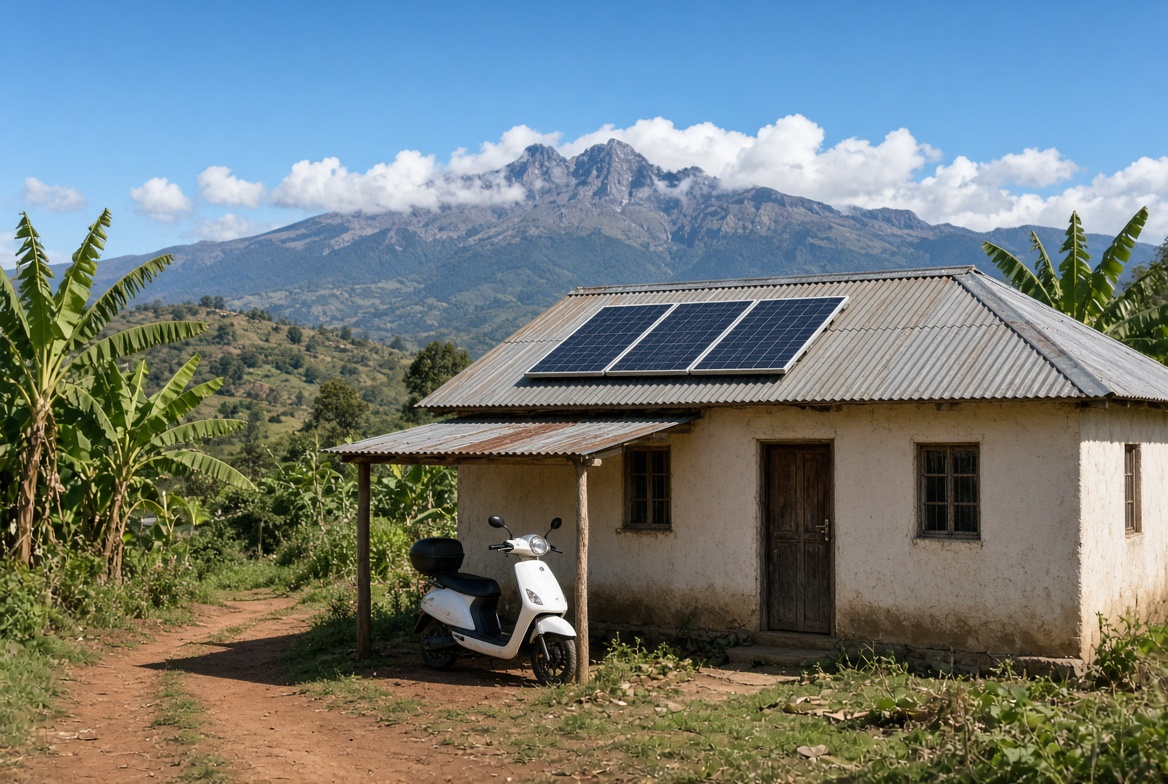 The image is from the PEGE energy sim manual. On the other side of the roof are 3 more 500 W PV modules. The examples show 3 rural areas in Africa without access to the power grid.
PEGE energy sim includes examples of very simple homes in rural areas of Africa. A 3 kWp PV system and 15 kWh of battery storage are sufficient for a basic standard of living: an electric scooter, air conditioning, electric cooking, and a refrigerator.
For a little more comfort and an electric car: a 6 kWp PV system and a 30 kWh battery. In practice, it happens every few years: “There’s no hot meal today, the sky is very cloudy, and the battery is almost empty.”
Why would such areas need an electric grid? Once the loan for the system has been paid off and only parts are being replaced, the electricity costs are lower than the grid fees in Austria.