New Grid Fee Model in Austria
This new grid fee model will also be introduced in other countries. Based on the information currently available, electric car drivers will not be able to avoid additional costs.
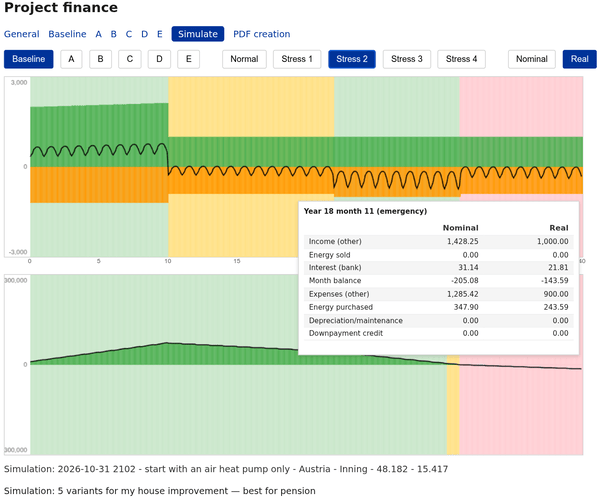 A snapshot of your financial future regarding housing and energy. In this example, the old house with a 16 kW heating load is retrofitted to a 4 kW heating load, and a slightly undersized heat pump, the 5.6 kW A5W35, is used. “Normal” means everything is running smoothly; “stress” means that after a definable number of years, an emergency occurs: unemployment or business failure.
The examples also include an off-grid setup in a very simple house, as is common in rural areas of Africa. While compiling the examples, I looked for a rural off-grid area in Kenya. The example was meant to show that air conditioning isn’t a problem, because when it’s hot—when the sun is shining—there’s enough electricity. You’d think it would be hot near the equator. Surprise: the air conditioner never ran at all, and the temperature chart showed that it can be significantly warmer in Salzburg than it is there. 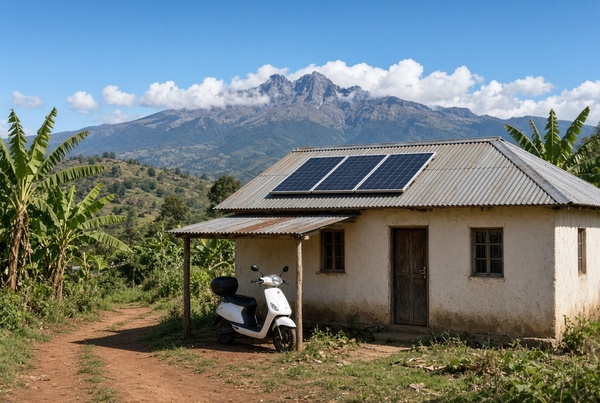 The answer to the riddle: The location is 1,622 meters above sea level on a plateau immediately south of Mount Kenya, the second-highest mountain in Africa.
Work on the simulation of houses is now complete. On Friday, I submitted the abstract for the CORP 2027 conference: “The Possibilities of Simulating Complex Energy Systems.” My abstract is also the last page of the manual. Download on the project page
|
Why a new network fee model?
|
This new grid fee model will also be introduced in other countries. Many years ago, a post kept popping up on social media that went, “And at 6 p.m., everyone drives home from work in their electric cars, plugs them in, and the power grid collapses.” It makes perfect sense: if 45 million cars in Germany were all charging at 11 kW, that would total 495 GW—more than five times the maximum grid load.
However, 50 km every day, 8 kWh, from 11:00 p.m. to 5:00 a.m. would only amount to 60 GW. That’s still too much for today’s grid, but it won’t be a problem by 2040.
Then there’s the switch from combustion-based heating to heat pumps. A heat pump design that doesn’t allow for two 2-hour breaks per day is junk. Those would be the two new high-demand consumers that we’d like to better integrate into the power grid through the new grid fees.
Austria-wide average (households, grid level 7):
- Long-term target values for E-Control (final stage, approx. 50:50, as of July 2026, Austrian average):
- Electricity rate: 4.53 ct/kWh (currently approx. 7.36 ct/kWh flat rate).
- Power rate up to 10 kW: 33.82 €/kW per year (approx. 2.82 €/month).
- Electricity rate for power above 10 kW: 67.64 €/kW per year (approx. 5.64 €/month).
- The flat fee and exhibition fee are waived.
- Minimum billing: 2 kW.
Example from the draft (Vienna network area, new structure, monthly):
- Up to 10 kW: 246 cents/kW.
- Over 10 kW: 369 cents/kW.
Prices vary significantly by grid area. For flexible consumption, the planned 75% discount on the flexible power component (i.e., only 25% of the regular price) will continue to apply. Important: At the start of 2027, the power price component will be lower than in the final phase. The exact amount per state or grid area will not be clear until the final SNE-T-V is published.
|
Unfortunately, only one design from Vienna is known
|
| Component |
Up to 10 kW |
Over 10 kW |
| Price-Performance Ratio |
246 cents/kW |
369 cents/kW |
| Energy Rate |
5.58 cents/kWh |
5.58 cents/kWh |
| SNAP / WiNAP |
4.46 cents/kWh |
4.46 cents/kWh |
Current status in the Vienna network area (network level 7, without power measurement):
- Electricity rate: 6.98 cents/kWh
- SNAP (Summer, 10 a.m.–4 p.m.): 5.58 cents/kWh
- Flat fee: 54 €/year
- Grid loss fee: 0.70 cents/kWh
Under the proposed plan, the energy rate would thus drop from 6.98 to 5.58 cents/kWh. In exchange, a capacity charge would be added. The flat fee and the metering fee would be eliminated under the new system.
|
How much would my 5,000 kWh have cost in Vienna?
|
Estimate using rounded numbers:
- 2,000 kWh * 5.58 cents SNAP electricity rate = 111.60 €
- 3,000 kWh * 6.98 cents per kWh = 209.40 €
- 54 € flat fee
- 354 € Total
With the new network fees, this would result in:
- 4,000 kWh * 4.46 cents SNAP / WiNAP
- 1,000 kWh * 5.58 cents per kWh (energy rate)
- 4 kW * 246 cents * 12 months (electricity rate)
- 6 kW * 246 cents * 0.25 * 12 months; electricity rate for consumption above 4 kW outside of off-peak hours
- €396.56 Total
A very significant increase. Currently, the minimum billing unit is supposed to be 4 kW, but it should be possible to lower that to 2 kW in the future. That would mean:
- 4,000 kWh * 4.46 cents SNAP / WiNAP
- 1,000 kWh * 5.58 cents per kWh (energy rate)
- 2 kW * 246 cents * 12 months (electricity rate)
- 8 kW * 246 cents * 0.25 * 12 months; power rate for consumption above 2 kW outside of off-peak hours
- €352.28 Total
Another strategy would be to charge at lower power levels during the winter months. During the summer months, the goal is to take advantage of low spot market prices during the day by charging at high power levels. During the winter months, on the other hand, charging could be done at low power levels at night.
- 4,000 kWh * 4.46 cents SNAP / WiNAP
- 1,000 kWh * 5.58 cents per kWh (energy rate)
- 4 kW * 246 cents * 12 months (electricity rate)
- 6 kW * 246 cents * 0.25 * 6 months; power rate for consumption above 4 kW outside of off-peak hours
- €376.42 Total
Another strategy would be to charge at night during the winter months at LIDL or a Tesla Supercharger. Currently, it’s 29 cents at the LIDL DC station and 27 cents/kWh at Tesla starting at 11:00 p.m. If I weren’t charging my car, I could get by with a peak power of 1.5 kW during the winter months.
- 2,000 kWh * 4.46 cents SNAP / WiNAP
- 1,000 kWh * 5.58 cents per kWh (energy rate)
- 4 kW * 246 cents * 6 months (electricity rate)
- 1.5 kW * 246 cents * 6 months (power rate)
- 6 kW * 246 cents * 0.25 * 6 months; power rate for consumption above 4 kW outside of off-peak hours
- €248.32 Total
While a spot market price of 0 cents plus fees is very affordable during the summer months, charging at home during the winter months is a convenience that comes at a cost.
|
Is one battery enough to get away?
|
5,000 kWh is 14 kWh per day. With storage losses of 15 kW per day. Power consumption at 2.5 kW is limited to SNAP WiNAP hours. Summer (daylight saving time) from 10:10 a.m. to 4:00 p.m. and winter from 11:00 p.m. to 5:00 a.m. are also the times with the lowest spot market prices.
- 5,400 kWh * 4.46 cents SNAP / WiNAP
- 2.5 kW * 246 cents * 12 months (power cost)
- €314.46 Total
Unfortunately, the benefit of the additional 400 kWh is negated by storage losses. There’s nothing left to offset the cost of purchasing the battery.
|
Escape Is Possible Only with Solar Power and a Battery
|
Add to that an EMS—an energy management system. Unfortunately, this means that most people cannot escape the effects of the new grid fee model. For electric car drivers without solar panels or a battery, there is no convenient strategy for keeping costs the same. I can’t describe the LIDL/Tesla SuC strategy during the winter months as convenient.
|
Who are we? Our shareholders
|
Who are we? Our shareholders. I ask all existing shareholders—and, hopefully, many new ones soon—to submit contributions like this.
So far, only 2% of our shareholders have become shareholders themselves by referring new shareholders. That number should increase significantly in the future. The offer is 10% of the purchased shares for a direct referral and 5% for an assist. I understand the term “assist” in the same way as in soccer: whoever passes the ball to the goal scorer has made an assist. |
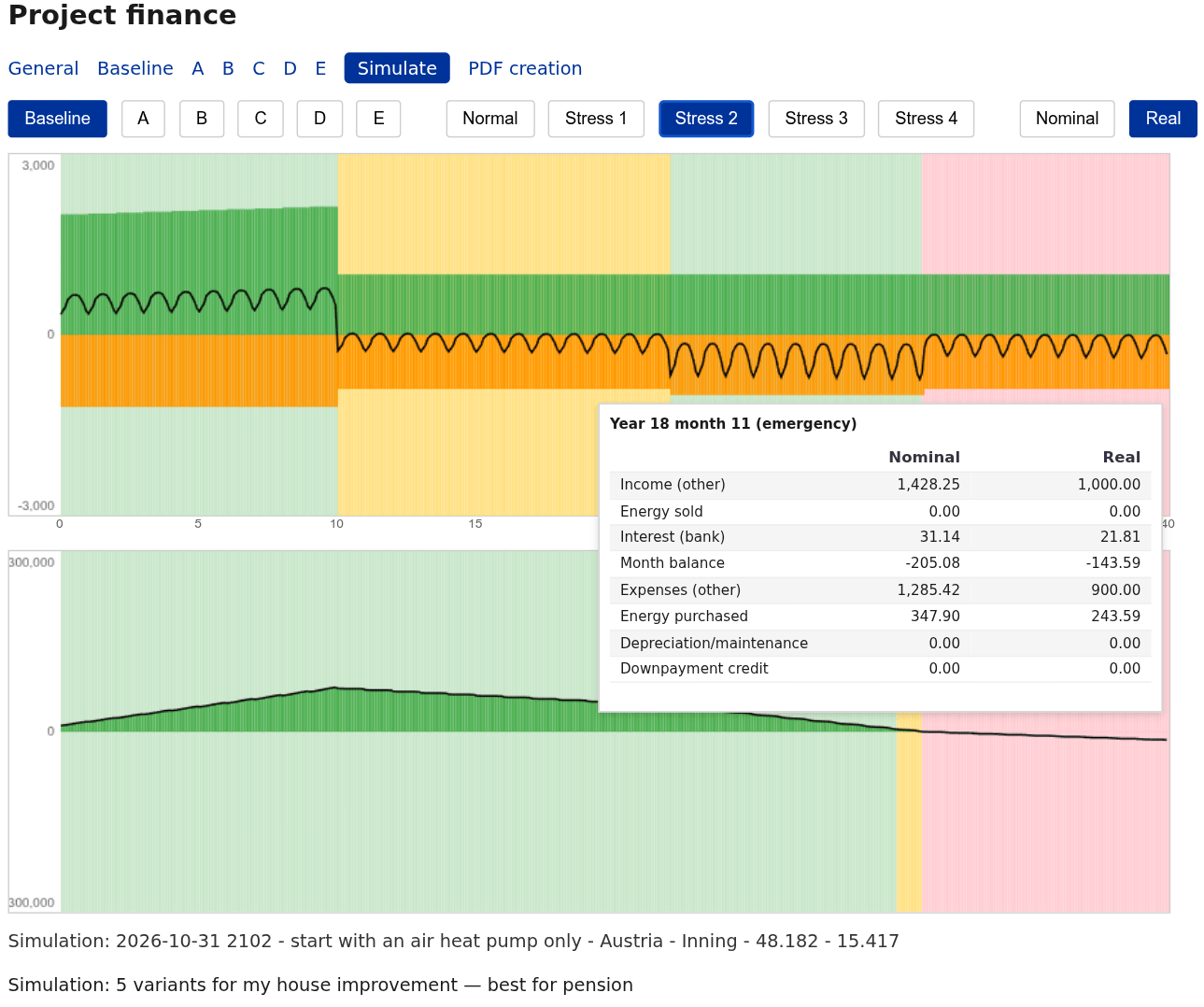 A snapshot of your financial future regarding housing and energy. In this example, the old house with a 16 kW heating load is retrofitted to a 4 kW heating load, and a slightly undersized heat pump, the 5.6 kW A5W35, is used. “Normal” means everything is running smoothly; “stress” means that after a definable number of years, an emergency occurs: unemployment or business failure.
The examples also include an off-grid setup in a very simple house, as is common in rural areas of Africa. While compiling the examples, I looked for a rural off-grid area in Kenya. The example was meant to show that air conditioning isn’t a problem, because when it’s hot—when the sun is shining—there’s enough electricity. You’d think it would be hot near the equator. Surprise: the air conditioner never ran at all, and the temperature chart showed that it can be significantly warmer in Salzburg than it is there.
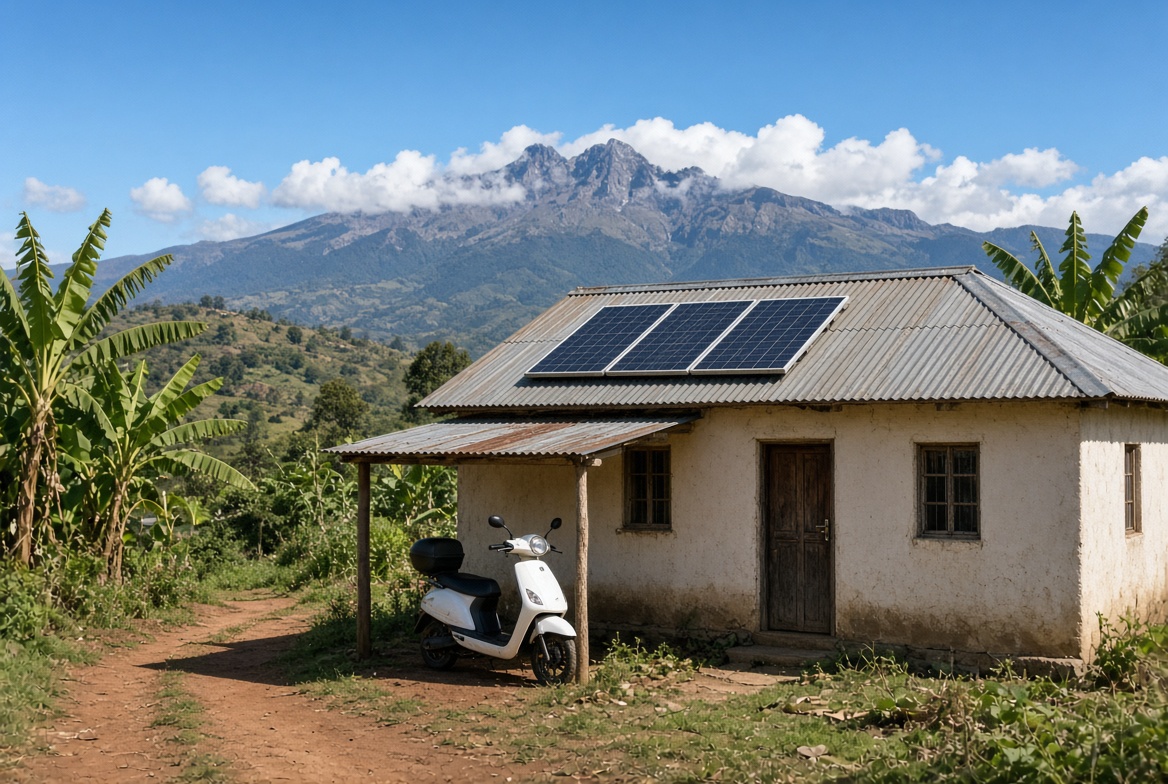 The answer to the riddle: The location is 1,622 meters above sea level on a plateau immediately south of Mount Kenya, the second-highest mountain in Africa.
Work on the simulation of houses is now complete. On Friday, I submitted the abstract for the CORP 2027 conference: “The Possibilities of Simulating Complex Energy Systems.” My abstract is also the last page of the manual. Download on the project page