Federal Network Agency Scenario Framework 2026: Summer Blackout
By 10:00 p.m., the batteries have discharged to 115.6 GWh. By 11:14 p.m., the batteries are empty, and the 80 GW of hydrogen power plants must take over 94.6 GW of the 100 GW grid load.
 Headline in the German mass media: 6,000 billion for the energy transition by 2045. Naturally, such mass media outlets don’t provide any details—just the big, sensational stories. To find out the details, I searched for “Federal Network Agency Climate-Neutral 2045 Scenario Framework” and found this page from the Federal Network Agency.
Click on the link on the page for “Scenario Framework for the 2040/2045 Electricity Grid Development Plan (as of June 2026) – Draft by the TSOs (pdf / 5 MB).”
The standard procedure is to first search for “GW.” I’m already on page 26, Key Figures for the Scenarios. In Scenario C 2045, 364.8 GWh of battery storage is compared to 400 GW of photovoltaic capacity. Oh, did I find an old PDF there? Back to page 1 right away. It says “Version 2027 Draft by the Transmission System Operators.” So it’s actually a document backdated to 2027.
|
Where does the electricity come from at night?
|
As is well known, the sun doesn’t shine at night in Germany. Even in the summer, there are 8 hours to get through. There are days when wind power accounts for less than 1% of installed capacity. The scenario framework calls for 238 GW of wind power, meaning 2 GW is supplied on a nearly windless summer night. There’s also 3 GW of biomass and 4.5 GW of hydropower. It could be incredibly dry. Hydropower would then supply only 0.4 GW.
Typical German electricity consumption (grid load) ranges from about 40 GW to 65 GW during the summer between 8:00 p.m. and 4:00 a.m. That’s the situation today. Scenario C calls for a doubling of electricity demand. The sun sets, and night begins. Let’s be generous and assume that at this point, the 346.8 GWh of batteries are fully charged. They certainly aren’t full, because photovoltaic output has been steadily decreasing between 4:00 p.m. and 8:00 p.m. But we want to be very kind and considerate toward the test subject.
130 GW of load at 8:00 p.m. This is offset by 2 GW of wind, 3 GW of biomass, and 0.4 GW of hydropower. Let’s look at a very simplified breakdown: 130 GW from 8:00 p.m. to 10:00 p.m., 100 GW from 10:00 p.m. to midnight, and 80 GW from midnight to 4:00 a.m. By 10:00 p.m., the batteries have dropped to 115.6 GWh. By 11:14 p.m., the batteries are empty, and the 80 GW of hydrogen power plants must take on 94.6 GW of the 100 GW grid load.
|
If a high school graduate fails even at 2 + 2
|
It’s completely pointless to continue the high school graduation exam in math with differential equations if the student already fails at 2 + 2. The longest day of the year—the sun shines for 16 hours, and at 11:14 p.m. there’s a blackout. That’s the high school graduate who answers “5” when asked “how much is 2 + 2”—that’s the Federal Network Agency’s scenario framework for 2045.
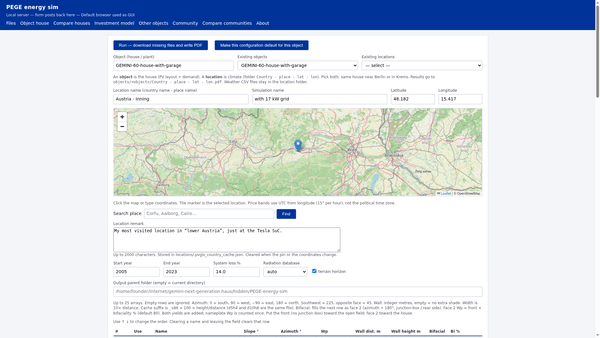
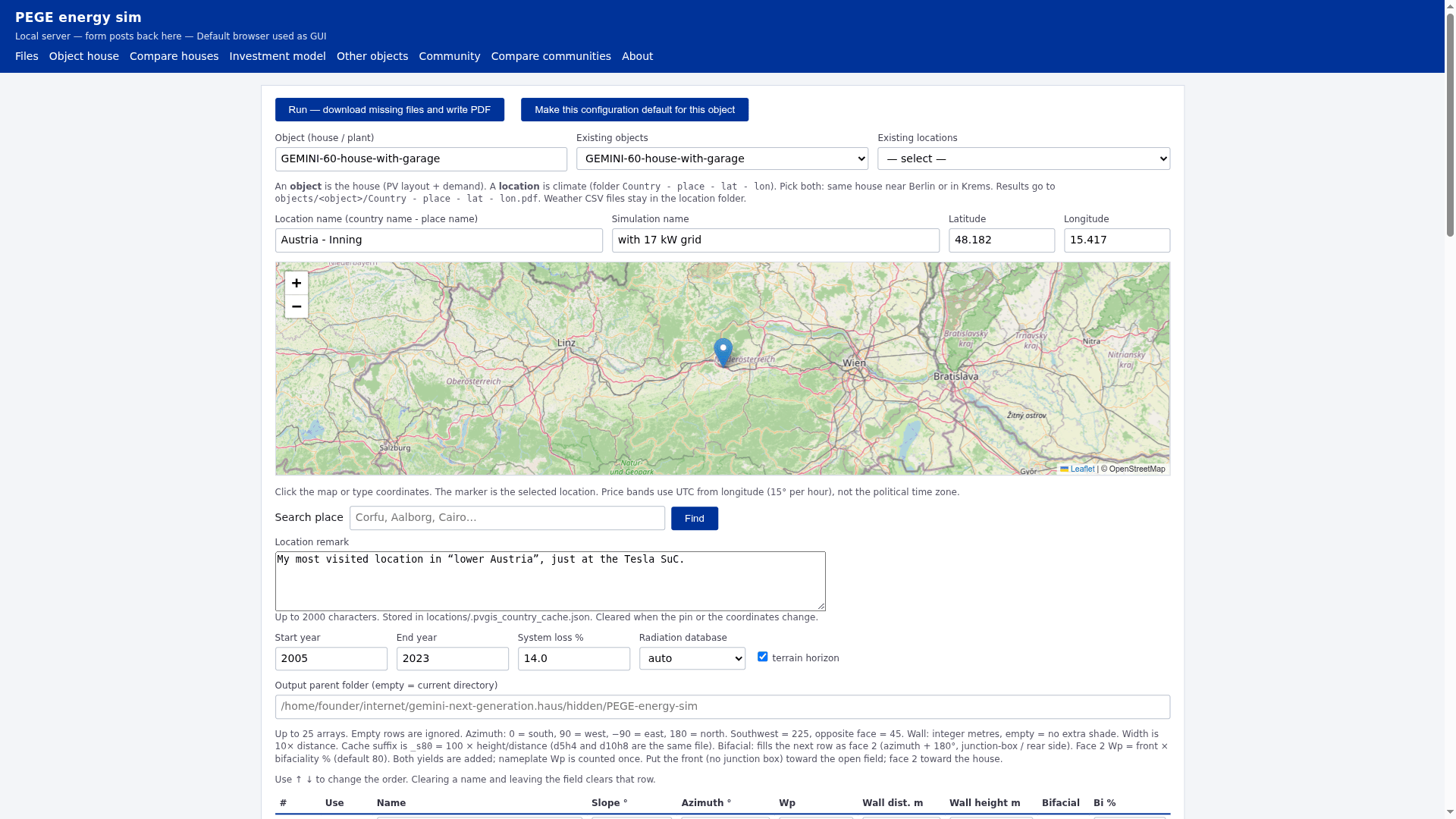
The software manual is now 27 pages long. The first version is about to be released. The first version focuses on how a house interacts with the existing system. The house interacts with the spot market via a pricing model that can be configured within the simulation.
Starting with version 1.0, a wide variety of objects can be defined. These different objects can then be grouped into communities. A very simple community would be, for example:
- 20 GEMINI Homes
- Fast-charging station
- Power to Methanol Tank Generator
There will be various types of industries that can be defined as entities to be tested within the community. Naturally, there will be no spot market, but rather optimized resource management.
If only because the spot market consumes an enormous amount of computing time. In the simulation, electricity import/export planning is carried out every day at 3:00 p.m. If you set the grid to 0, the simulation runs five times faster because no spot market import/export planning needs to be performed.
|
From a Case in Need of Restructuring to a Model for Others to Follow
|
One of the scenarios in the simulation is a house built in 1960 with a heating load of 16 kW. First, a thermal retrofit and a slightly undersized air-source heat pump: a 5.6 kW A0W35 unit is paired with a 4 kW heating load at -10°C, resulting in catastrophic use of the heating elements on very cold days. Step by step, the simulation demonstrates the use of the EWG (Energy Heat Garage), wall-mounted air heating, individual-room ventilation with heat recovery, and, above all, an increasing amount of photovoltaic power.
Without simulation, I would keep hearing the question, “And what’s the point of that, anyway?”
Total available thrust: 250 kg of air × 320 m/sec (just below the speed of sound) = 80 kN. For hydrogen, it takes 5 kWh/kg to compress the hydrogen into a 700-bar high-pressure tank. With air, the energy required per kg is only one-tenth as much. The battery is unlikely to be sufficient to recharge the pressure tank while driving.
The downforce generated at the ground was demonstrated using fans and air jets. Downforce generated by fans occurred only once in Formula 1: A Brabham BT46B won in Sweden in 1978 by a staggering margin. The other teams protested so vehemently that this design was immediately banned.
The roadster could achieve lap times of 6:20 at the Nürburgring with this setup. The air vents would play no role in this, because they are far too limited in their effectiveness. Cars are designed for a specific payload. For example, 1,500 kg when empty and 2,000 kg when fully loaded. With the vacuum system, however, the empty weight could be 1,500 kg without the vacuum and 4,500 kg with it. The chassis must be designed to handle very demanding conditions.
How effective is downforce at speeds of 80 to 150 km/h in increasing cornering speed?
I currently have the US$30-per-month subscription from Grok.
- October 4, 2026, 11:50 a.m. Weekly allowance used up; sending US$ 20
- October 4, 2026, 2:50 p.m. Spent US$ 20, sending US$ 20
- October 8, 2026, 11:48 p.m. US$ 16.67 spent; new weekly allowance allocated
- October 13, 2026, 8:00 a.m. Grok sends an email: It was a glitch that has now been fixed; the weekly counter can be reset from 62% to 0%.
- October 15, 2026, 11:47 p.m. 94% used; thanks to Grok's refund this week, 62 × 94 = 156% of the weekly allowance has been used
If there were more granular subscription tiers—say, the next tier at US$50 per month—I would switch right now. US$100 per month would still be unprofitable at this point.
|
Who are we? Our shareholders
|
Who are we? Our shareholders. I ask all existing shareholders—and, hopefully, many new ones soon—to submit contributions like this.
So far, only 2% of our shareholders have become shareholders themselves by referring new shareholders. That number should increase significantly in the future. The offer is 10% of the purchased shares for a direct referral and 5% for an assist. I understand the term “assist” in the same way as in soccer: whoever passes the ball to the goal scorer has made an assist. |
 Headline in the German mass media: 6,000 billion for the energy transition by 2045. Naturally, such mass media outlets don’t provide any details—just the big, sensational stories. To find out the details, I searched for “Federal Network Agency Climate-Neutral 2045 Scenario Framework” and found this page from the Federal Network Agency.