Efficient Mobility Through the Ages
My actual electricity costs for my Tesla Y are far lower than anything that was ever possible with an internal combustion engine. This includes extreme prototypes like the Loremo.
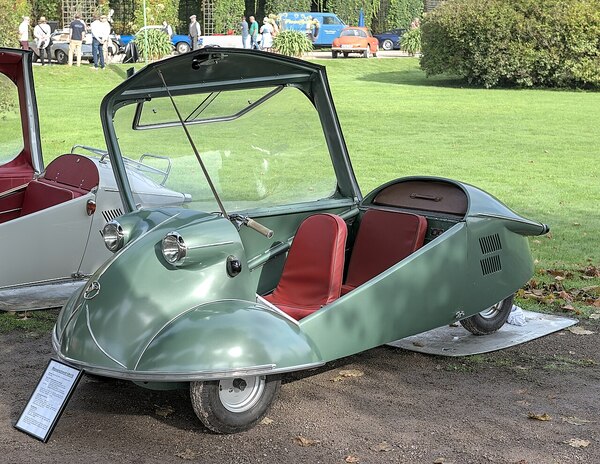 Let's start with fuel-efficient transportation in 1950. Germany's industrial capacity was still limited; the moped was the stuff of dreams, and cars were only for the rich. A moped like that consumed 4 liters per 100 km.
The Messerschmitt Kabinenroller was sort of like a car: a great way to save money, but the lousy engine still guzzled 5.5 liters per 100 km.
The Messerschmitt Kabinenroller lost out in 1961 to the worst gas guzzler of all time among small cars: the VW Beetle. It consumed 10 liters instead of 5.5 liters, but it had 5 seats instead of 2.
Let's start with fuel-efficient transportation in 1950. Germany's industrial capacity was still limited; the moped was the stuff of dreams, and cars were only for the rich. A moped like that consumed 4 liters per 100 km.
The Messerschmitt Kabinenroller was sort of like a car: a great way to save money, but the lousy engine still guzzled 5.5 liters per 100 km.
The Messerschmitt Kabinenroller lost out in 1961 to the worst gas guzzler of all time among small cars: the VW Beetle. It consumed 10 liters instead of 5.5 liters, but it had 5 seats instead of 2.
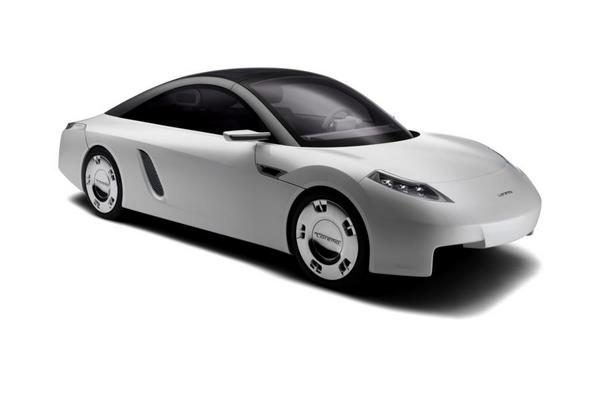 From 2005 until the very end, I followed the Loremo project very closely. I was constantly on the Loremo forum and thought they should turn the Loremo into a 5-kWh electric car instead of a 1.5-liter diesel car.
The logic was compelling: the Loremo made its first trade show appearances as an electric car. The reasoning behind this: With a battery price of €1,500 per kWh, you can easily get a range of 300 km from 15 kWh of battery capacity.
I even ran some plug-in hybrid calculations: a 10 kWh battery and a cheap €200 generator with 3 kW would be enough to get me through all of Romania. Back then, it was all country roads, so at an average speed of 60 km/h, there was enough time for a 3 kW generator to produce enough electricity for 100 km. As logical as a plug-in hybrid was at €1,500 per kWh for the battery, it’s just as illogical today at €100 per kWh.
The various prototypes were:
From 2005 until the very end, I followed the Loremo project very closely. I was constantly on the Loremo forum and thought they should turn the Loremo into a 5-kWh electric car instead of a 1.5-liter diesel car.
The logic was compelling: the Loremo made its first trade show appearances as an electric car. The reasoning behind this: With a battery price of €1,500 per kWh, you can easily get a range of 300 km from 15 kWh of battery capacity.
I even ran some plug-in hybrid calculations: a 10 kWh battery and a cheap €200 generator with 3 kW would be enough to get me through all of Romania. Back then, it was all country roads, so at an average speed of 60 km/h, there was enough time for a 3 kW generator to produce enough electricity for 100 km. As logical as a plug-in hybrid was at €1,500 per kWh for the battery, it’s just as illogical today at €100 per kWh.
The various prototypes were:
- Length: 3,800 mm to 3,840 mm (3.80 – 3.84 meters)
- Width: 1,360 mm to 1,400 mm (1.36 – 1.40 meters)
- Height: 1,100 mm to 1,140 mm (1.10 – 1.14 meters)
|
Piech and the 1-liter car
|
In 2010, Piech tried to convince some environmental groups: A 1- or 2-liter car is better than an electric car.
- Piech knew full well that the 1-liter car wouldn't work, not even with a cab-style design featuring two seats in a row.
- Piech knew full well that the 2-liter car had to be designed to be as extreme as the Loremo.
- Piech knew full well that the gas-guzzling VW Beetle had driven the Messerschmitt Kabinenroller out of the market.
But the environmental groups that had grown up in the "save, cut back, do without" movement believed him. At the time, there was a campaign against electric cars.
Back then, I also wrote about what would happen if 10 kWh of solar power became cheaper than 1 liter of diesel. The last sentence in my 2010 article about Ferdinand Piech has become a grim reality:
Those who are late to the electric car game will pay the price—unfortunately, the innocent VW workers will bear the brunt of it.
|
German Government Cuts Diesel Price by 17 Cents
|
Even 10 kWh of solar power—converted to 24-Volt electricity using batteries—has long been much cheaper than a liter of diesel. In the profitability calculations for the GEMINI House, I used 10 cents/kWh as a very conservative estimate of the sales revenue per kWh.
When traveling long distances, it's not the selling price of the electricity you generate yourself that matters, but rather what it costs at the charging station.
In May, I tracked the cost of a trip from Salzburg to Budapest, several days in Budapest, and back to Salzburg: 1,269 km at an electricity cost of €3.22 per 100 km.
If the price of diesel in Germany drops from €2.50 to €2.33, then—based on diesel costs—my Tesla Y goes from being a 1.3-liter car to a 1.4-liter car.
Even at Loremo, they could only dream of a 1.5-liter car: weighing 450 kg, very low to the ground, very narrow, with two rear seats facing backward.
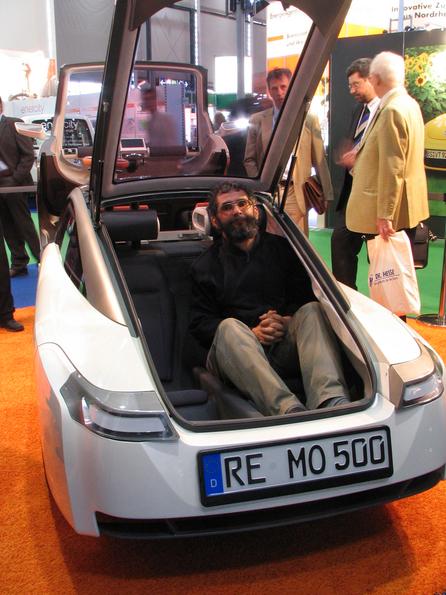 Looking at the photo, I'm wondering: where would there have been room for one more person in the back?
|
VW Efficiency Initiative: it is a Joke
|
It's a complete mystery what VW hopes to achieve with its Efficiency Initiative.
- No screen—bring your own device
- No speakers—bring your own Bluetooth speakers
- Only 4 seats, and the rear seats are suitable only for passengers up to 160 cm in height
On the documented Wolfsburg–Vienna route (1,278.36 km, average speed 67.72 km/h): 6.89 kWh/100 km without charging losses and 7.51 kWh/100 km with charging losses. One charging stop; remaining range in Vienna: 164 km.
My most fuel-efficient drives in the Tesla Y were just under 11 kWh/100 km, excluding charging losses. With special tires, it would probably be possible to get below 10 kWh/100 km. With the newer Tesla Y Juniper, it’s certainly possible to get below 9 kWh/100 km with special tires.
So what is Volkswagen trying to prove with this?
- Is 5.5 l/100 km instead of 10 l/100 km worth giving up three seats (Messerschmitt Kabinenroller vs. 1960 VW Beetle)?
- Is saving 1.5 liters instead of 5 liters per 100 km worth having only two passengers sit facing the rear in the back seat? (Loremo vs. a 2008 diesel compact car)?
- Is a WLTP fuel consumption figure of 8.4 kWh per 100 km—instead of 13 kWh—worth having to carry everything with you and having only very short people able to sit in the back?
8.4 kWh/100 km is the WLTP figure for the VW efficiency. 13 kWh/100 km is the WLTP figure for the Tesla Y SR Juniper.
Where VW really needs to cut costs: the list of optional accessories. It’s a huge list of accessories that come standard on Tesla vehicles.
If you're really that concerned about efficiency, how can you justify a €1,090 surcharge for a heat pump instead of electric heating alone?
| Topic
| ID.3 Neo Trend
| Model 3
|
| Heat Pump
| Extra (often ~€1,000 or a leasing surcharge)
| Series
|
| Navigation System with Charging Planning
| Extra (Trend: Smartphone Navigation via CarPlay/Android Auto)
| Series (with built-in supercharger routing)
|
| Heated Steering Wheel
| On-Demand / Winter Package / First Style Series
| Series
|
| Heated front seats
| Winter Collection / Style
| Series (Highland)
|
| Heated windshield
| not basic
| Series
|
| Panoramic Glass Roof
| Extra
| Series
|
| Matrix/Adaptive High Beams
| Extra (IQ.LIGHT, Style 1)
| Standard (adaptive high beams)
|
| Rearview Camera
| Extra (Life)
| Series (Cameras All Around)
|
| 360° / Surround-View Cameras
| Extra (Area View / Assistance Package)
| Series (8 outdoor cameras)
|
| Inductive Smartphone Charging
| Extra (Life)
| Series (Highland)
|
| Alloy Wheels
| Extra (Trend, often steel/base; Life 18")
| Series
|
| Keyless Access (unlock without inserting a key)
| Often an extra feature; the Trend model has keyless start
| Series App/Phone Key
|
| Power Tailgate / Hands-Free
| Extra
| Series (Hands-Free Trunk)
|
| Full-featured autopilot base (lane-keeping linked to ACC)
| ACC Lane Assist Series; Travel Assist Extra
| Basic Autopilot Series
|
| Supercharger Access / Network-Wide Routing
| No Tesla network
| Series
|
| Frunk
| none
| Series
|
| OTA Updates as a Core Product
| limited (We Connect / ID. Software)
| Series, frequently
|
| Rider Profiles / Easy Entry
| limited
| Series
|
| Sentry/Dashcam Onboard Cameras
| Not comparable to the series
| Series (Camera Hardware)
|
|
Looking for Home Renovation Projects
|
I've already got 4 projects. They're spread out all over the place: Burgenland, the Elbe, Bremen, and Switzerland. I'd love to take on more projects.
 The wall heater's electronics: a power supply, a PWM controller for the fans, and a microcomputer with Wi-Fi and Zigbee for control.
|
Who are we? Our shareholders
|
Who are we? Our shareholders. I ask all of our existing shareholders—and, hopefully, many new ones soon—to submit contributions like this.
So far, only 2% of our shareholders have become shareholders themselves by referring new shareholders. That number should increase significantly in the future. The offer is 10% of the purchased shares for a direct referral and 5% for an assist. I understand the term “assist” in the same way as in soccer: whoever passes the ball to the goal scorer has made an assist. |
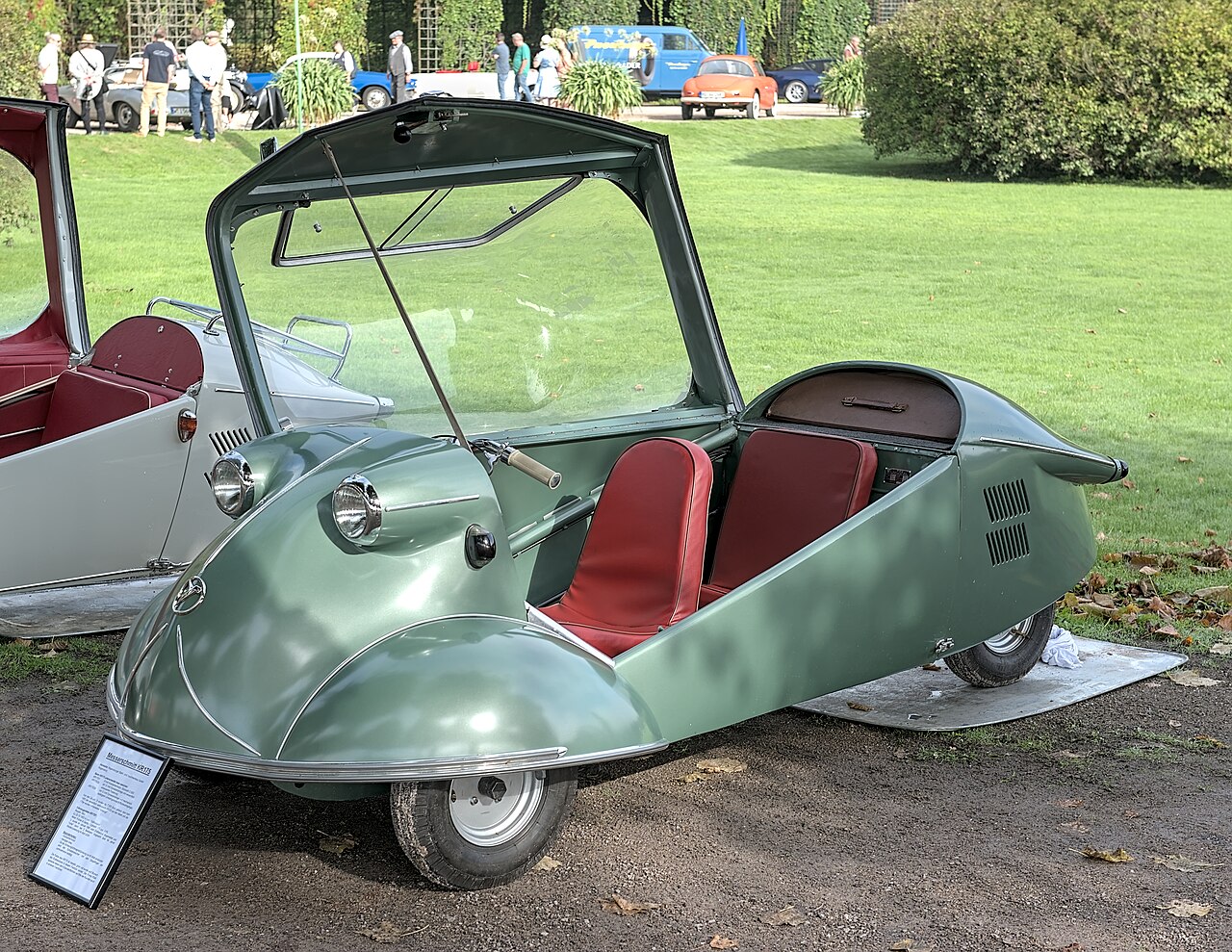 Let's start with fuel-efficient transportation in 1950. Germany's industrial capacity was still limited; the moped was the stuff of dreams, and cars were only for the rich. A moped like that consumed 4 liters per 100 km.
The Messerschmitt Kabinenroller was sort of like a car: a great way to save money, but the lousy engine still guzzled 5.5 liters per 100 km.
Let's start with fuel-efficient transportation in 1950. Germany's industrial capacity was still limited; the moped was the stuff of dreams, and cars were only for the rich. A moped like that consumed 4 liters per 100 km.
The Messerschmitt Kabinenroller was sort of like a car: a great way to save money, but the lousy engine still guzzled 5.5 liters per 100 km.