GEMINI: More Space for Technology
The GEMINI House is actually a 1.5-story house with one full story of living space and a half-story of utility space with drawers serving as a substitute for a basement.
Which technology takes up the least space in a house? The electricity that comes out of the outlet. Infrared panels mounted on the wall that are just a few millimeters thick, a 22-kW instantaneous water heater for hot water—that’s it.
Propane takes up a little more space. But everything is still super cheap. You can find a propane-powered instant water heater like this on Alibaba for around 50 €.
|
Power generation and high efficiency require space
|
60 modules measuring 2,378 mm by 1,134 mm already cover 160 m². At 30 mm thick, that’s nearly 5 m³ of equipment. Add to that 160 kWh of batteries and the inverters. They also take up a lot of space—not just the batteries, but also the fire protection required for systems of 100 kWh or more. Enclose the equipment room with 100 mm steel-mineral wool panels, and the problem is solved. How do you avoid a conflict of priorities between “more living space” and “enough room for the equipment”?
It's simple: you just put all the equipment in a 1.4-meter-high room below the living area. Nobody wants a 1.4-meter-high living space—problem solved.
How did this happen? Because of the 4-meter height limit for road traffic. The GEMINI house was supposed to be transported to its installation site in six parts, pushing the limits of what was possible. So there’s the 2.5-meter-high living area, with the roof above it and the floor below it, plus the 550-mm-high trailer. What to do with whatever space is left within the 4-meter height limit?
These considerations led to the design of the low-temperature thermal storage tank beneath the house and the drawer system as a substitute for a basement. Of course, with a height of 4 m, you can’t fit two stories, but you can fit one story and have plenty of space for the technical systems. The 40 m³ low-temperature thermal storage tank is also designed to boost efficiency: it extracts heat from the air only during the warmest hours of the day; during a cold snap, cooling 40 m³ of water from 20° to 5° provides 696 kWh of stored heat.
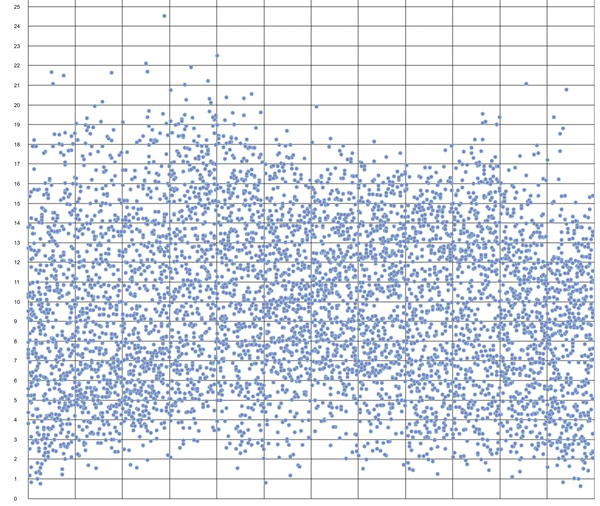 Temperature difference between the warmest and coldest hours of the day from 2005 to 2020 in Salzburg. From left to right: January through December. From top to bottom: 25° to 0° difference.
There’s the water heater. Tap water flows into it and is heated. You can shower until the water heater is empty. The entire contents of the water heater must be heated to over 60° on a regular basis to kill Legionella bacteria. At such high temperatures, a heat pump’s coefficient of performance drops considerably. The other method is the fresh water station. It consists of a tank of hot water and a plate heat exchanger. As soon as a hot-water faucet is turned on, tap water flows through one side of the plate heat exchanger, and on the other side, water from the tank is pumped through by a pump.
Conventional systems typically use a tank temperature of 50°. In the GEMINI house, this is designed for 42°. A generously sized plate heat exchanger that heats the tap water to 41°, and a large tank with substantial thermal insulation. How about a 1 m³ water tank insulated with 20 cm of PIR foam? That’s only 2.75 m³—you simply can’t fit that much into a conventional house.
Temperature difference between the warmest and coldest hours of the day from 2005 to 2020 in Salzburg. From left to right: January through December. From top to bottom: 25° to 0° difference.
There’s the water heater. Tap water flows into it and is heated. You can shower until the water heater is empty. The entire contents of the water heater must be heated to over 60° on a regular basis to kill Legionella bacteria. At such high temperatures, a heat pump’s coefficient of performance drops considerably. The other method is the fresh water station. It consists of a tank of hot water and a plate heat exchanger. As soon as a hot-water faucet is turned on, tap water flows through one side of the plate heat exchanger, and on the other side, water from the tank is pumped through by a pump.
Conventional systems typically use a tank temperature of 50°. In the GEMINI house, this is designed for 42°. A generously sized plate heat exchanger that heats the tap water to 41°, and a large tank with substantial thermal insulation. How about a 1 m³ water tank insulated with 20 cm of PIR foam? That’s only 2.75 m³—you simply can’t fit that much into a conventional house.
|
| GEMINI 1000 L
| Premium 500 L
|
| Volume in liters
| 1,000
| 500
|
| Water Temperature
| 42°
| 50°
|
| Heat loss at approximately 20° in W
| 33
| 80
|
| Annual heat loss in kWh
| 289
| 701
|
| Heat Pump Coefficient of Performance
| 3.4
| 2.9
|
| Annual electricity consumption (kWh)
| 85
| 242
|
Those are just the standby losses—simply to keep the water in the tank warm. The difference is equivalent to driving about 1,000 km per year. It also doesn’t cost any more than the 500-liter tank with “premium” insulation. It just takes up a lot more space.
|
World Record in Hot Water Production
|
I’ve already had a video conference with a team from the Guinness Book of World Records about this: the world record for hot water efficiency. The trick is that the tap water can be as low as 5° in the winter. First, it is heated to 15° via a plate heat exchanger from the low-temperature heat storage tank. The next plate heat exchanger draws 27° water from the buffer tank for the heating system. The third plate heat exchanger extracts heat from the 42° storage tank for domestic hot water. In this way, most of the heating takes place with significantly better efficiency ratios than would be possible at 42°.
|
Fewer cycles of the heat pump
|
Early heat pumps could only be turned on and off. Almost all heat pumps in use today have an inverter, which regulates the compressor’s speed. But if a 5.6 kW heat pump has a minimum output of 1.7 kW, that can still be far too much. This heat pump has various functions: heating, cooling, providing hot water, and possibly even heating a small pool. In a well-insulated house, even 1.7 kW is too much, even at -10°C. In that case, you have to switch it on and off again: set the inverter to the lowest setting, but it still needs to be turned on and off.
How often? Less than 10 times a day is considered ideal. More than 50 starts per day are considered sloppy. If the heat pump outputs at least 1.7 kW and the heating load is 0.5 kW, then that’s 1.2 kW too much. With a generously sized buffer tank, it would last for 8 hours, which would mean only 3 cycles per day. It can handle anything—it’s just a matter of space.
|
Ventilation System with Heat Recovery
|
In older buildings, an individual room ventilation system is almost the only option: use a slightly larger hole-cutting saw to cut a 150 mm hole in the wall and install the ventilation unit there. For a central ventilation system, you’ll need ventilation ducts. These should have a diameter of 200 mm, which makes maintenance much easier and ensures very little noise and power consumption. Who can easily install a 200 mm pipe in the ceiling? Over the course of a year, the difference between 13 W and 30 W with 130 mm pipes amounts to 150 kWh. The advantage over single-room ventilation: Air enters the living room and bedroom and is extracted from the bathroom, toilet, and kitchen. These are referred to as supply-air and exhaust-air rooms.
Here's my video about the ventilation system.
|
The GEMINI House is actually
|
The GEMINI House is actually a 1.5-story house with one story of living space and a half-story of utility space with drawers serving as a substitute for a basement. If it had two stories, the debate over every square meter of utility space would begin immediately: Wouldn’t it be better to use that square meter for living space instead of for utilities?
|
EWG - Energy, Heat, Garage
|
What should you do when renovating an older home if there simply isn’t enough space for all the new technology? I know of a wooden house built in 2000 where the gas heating system is housed in a 2 m² storage closet. The EWG (Energy Heat Garage) was designed as a solution. But even here, there are significant limitations: only 3 instead of 11 15-kWh batteries. No room for a buffer tank. Instead of a low-temperature heat storage tank, a grid of boreholes 3 to 9 meters deep beneath the garage.
A few days ago, someone brought a tiny house project to my attention: 28 m² for seasonal workers in the restaurant industry. It’s a great idea—back in the day, seasonal workers used to be housed in attics and basements.
It's as if to say that anyone who works all day has no right to expect comfort at home. They just collapse into bed, exhausted, and are woken up again before their shift begins.
Some people can’t resist solving any puzzle; I can’t resist solving any energy puzzle. A heat pump—where to put it, and above all, where can you find one for a very small heating load? I quickly turned to PCM—phase change materials—to avoid the constant cycling of an oversized heat pump. It’s expensive, but when you don’t have the space, the only way to make up for it is with more money. My search on Alibaba for ready-made PCM heat storage units turned up nothing. Shortly afterward, however, I received an ad on my cell phone from a Swiss company. They have ready-made PCM storage units. I haven’t received a price list yet, but I suspect the prices will be higher than on Alibaba.
|
Looking for Home Renovation Projects
|
I've already got 4 projects. They're spread out all over the place: Burgenland, the Elbe, Bremen, and Switzerland. I'd love to take on more projects.
 The wall heater's electronics: a power supply, a PWM controller for the fans, and a microcomputer with Wi-Fi and Zigbee for control.
|
Who are we? Our shareholders
|
Who are we? Our shareholders. I ask all existing shareholders—and, hopefully, many new ones soon—to submit contributions like this.
So far, only 2% of our shareholders have become shareholders themselves by referring new shareholders. That number should increase significantly in the future. The offer is 10% of the purchased shares for a direct referral and 5% for an assist. I understand the term “assist” in the same way as in soccer: whoever passes the ball to the goal scorer has made an assist. |
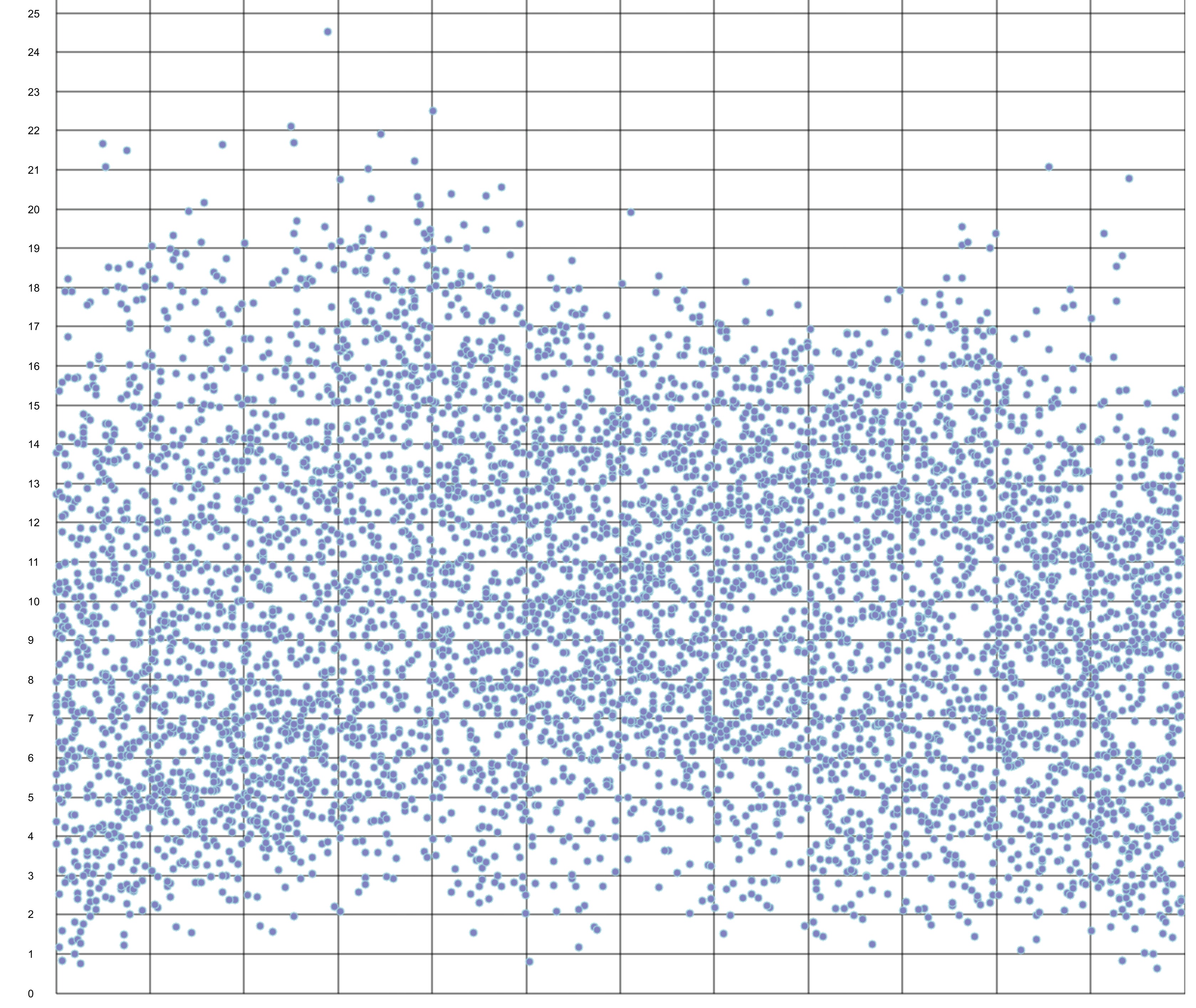 Temperature difference between the warmest and coldest hours of the day from 2005 to 2020 in Salzburg. From left to right: January through December. From top to bottom: 25° to 0° difference.