Nuclear Power Plant Outages in Hungary and Romania
A Way Out of Hungary’s Electricity and Housing Crises: Replace Nuclear Power Plants in the Summer. If these plants operate less and less only during the winter months, they will be sufficient to meet the demand for 100% renewable energy.
Currently, 0 of 1.3 GW of nuclear power is online in Romania, and 0.42 of 1.92 GW in Hungary. Earlier this week, the figure was as low as just under 0.12 GW. That’s reason enough to try publishing an article in the Hungarian media for the first time.
|
The Paks Nuclear Power Plant was designed before climate change became an issue
|
The first reactor at Paks was connected to the power grid in 1982. Its design was based on a 100-year low-water level. However, the water level fell 1 meter below that level as early as 2018, and this year it was even 1.28 meters below it.
Climate change is setting new records in both directions—higher flood levels and lower low-water levels, with the latter expected to occur primarily in the summer and early fall in the future.
The last time water levels were extremely low was on October 26, 2018.
But water temperatures are also rising to dangerous levels: When the Danube is between 10° C and 15° C, it’s no problem to return the 100 cubic meters of cooling water required per second to the river at a temperature that’s 8° to 10° warmer.
At that time, full capacity would have been possible if Unit 2 hadn't been shut down due to a technical malfunction.
If the Danube is 28°, that leaves only 2° until it reaches the permitted upper limit of 30°.
Low water levels mean less water, and the water is also warmer; however, they are not as critical in the fall as they are in the summer because of the lower water temperature.
So there’s nothing more logical than replacing Paks entirely or partially with solar power in the summer. If this were to be done entirely, the 8.6 gigawatts of photovoltaic capacity already installed in Hungary would need to be increased by 11.5 GW and combined with 34.5 GWh of battery storage (currently less than 2 GWh is installed).
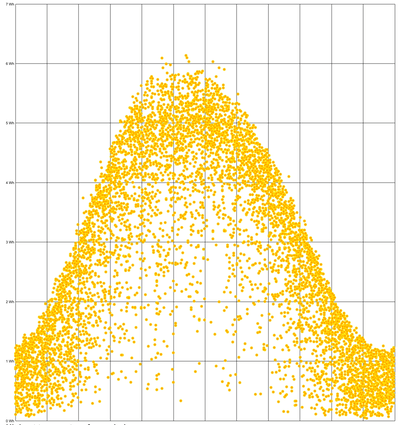 Daily solar output in Budapest from 2005 through the end of 2023.
|
Resolving the Housing Crisis and the Energy Crisis
|
To bring about a noticeable easing of the housing market and a meaningful renovation of the (often energy-inefficient) building stock, at least 30,000 new housing units per year would be needed on a long-term basis. That is more than twice as many as were built during the crisis years of 2024 and 2025.
Since 1991, the GEMINI project (Latin for “twin”) has been promoting the dual use of buildings for both residential purposes and electricity generation. In 2001, the GEMINI habitable solar power plant was the main attraction at the Styrian State Energy Exhibition in Weiz.
However, with an annual photovoltaic production of just 380 MW at about 4,000 €/kWp and 4 GWh of lithium-ion battery production at about 2,000 €/kWh, this vision for the future still lacked the economic viability that is now beyond doubt.
Hungary alone will have 20 times more battery production in 2026.
A generation later, the GEMINI next Generation project—which gave the initiative its name—was launched. Given today’s photovoltaic prices, the only thing that matters is maximizing the available surface area, preferably on an east-west-facing roof. In terms of material costs, even a north-facing facade equipped with photovoltaics is now economically viable.
Where else, besides on the house and garage, could solar panels be installed? The driveway, shaded areas for residents, and parking lot canopies in a housing development.
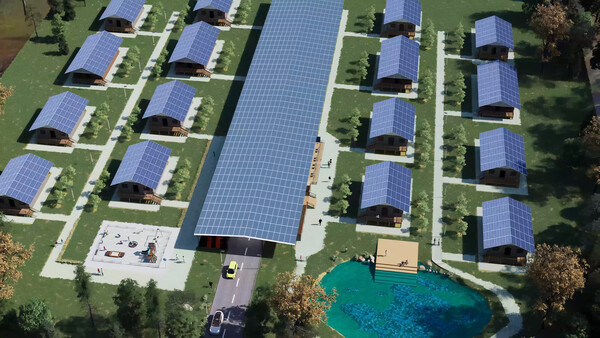 The result of these considerations is an “energy-optimized community”: 16 houses per hectare, 1.34 MWp of photovoltaic capacity, and 4 MWh of battery storage to convert the solar power into 24-hour electricity.
20,000 new housing units per year in the form of such energy-optimized residential areas would equate to 1.67 GWp of photovoltaic capacity and 5 GWh of battery storage. Replacing the Paks nuclear power plant during the summer months would therefore realistically be achievable in just under 7 years once mass production begins.
The result of these considerations is an “energy-optimized community”: 16 houses per hectare, 1.34 MWp of photovoltaic capacity, and 4 MWh of battery storage to convert the solar power into 24-hour electricity.
20,000 new housing units per year in the form of such energy-optimized residential areas would equate to 1.67 GWp of photovoltaic capacity and 5 GWh of battery storage. Replacing the Paks nuclear power plant during the summer months would therefore realistically be achievable in just under 7 years once mass production begins.
|
Self-Sufficiency: Energy Income Instead of Energy Expenditures
|
A typical family living in an old house in the countryside has monthly energy expenses ranging from 105,000 to 180,000 forint. How about turning that around?
With an 84-kW photovoltaic system and 250-kWh batteries, self-sufficiency is guaranteed even on a heavily overcast December day.
Over the course of the year, personal consumption accounts for about 9% of the electricity generated by the rooftop system. Naturally, it’s much cheaper to use your own electricity than imported oil. So 91% of the electricity is sold.
Even if we can’t expect the spot market prices—which have been incredibly high for sellers—to continue in the future, a price for 24-Strom that is more oriented toward the broader societal benefit would still be enough to turn the tide at Energie.
|
From 24-hour power to 24×365 power
|
The large variations in daily output cannot be overcome by batteries alone. Even at just 15,000 forint per kWh, it is far too expensive to charge a huge number of batteries in the summer and discharge them in the winter.
We need a much cheaper storage solution, even if it has very low efficiency: converting PV electricity into methane or methanol.
The threshold for converting solar power into 24-hour electricity—which we need to achieve 24 hours a day, 365 days a year—is 25 GW of photovoltaic capacity and 75 GWh of battery storage in Hungary. This could result in surplus electricity that cannot be utilized via batteries, which can then be converted using the “power-to-methanol” process.
|
Hungary with 100% Renewable Energy
|
This goes far beyond the transition from internal combustion engines to electric cars, or from combustion-based heating to heat pumps. Above all, there’s also energy-intensive industry:
Cement plants are switching from clinker produced by combustion to clinker heated with electricity. For Hungarian cement production, this represents an additional demand of nearly 1 TWh/year.
GEMINI next-generation homes are concrete-free, but in countries with a high proportion of electric cars, people are already considering using concrete for roads because asphalt is a byproduct of petroleum processing.
Until 2019, Dunaferr produced up to 2 million metric tons of steel annually. If it were to use electricity and hydrogen to reduce the iron ore, that would require 8 TWh of electricity per year.
There is a huge difference between switching a single household to 100% renewable energy and doing the same for an industrialized nation.
Once there is so much solar power that the surplus has to be converted into power-to-methanol or methane, operating a nuclear power plant no longer makes sense.
The situation is quite different during the winter months: Due to the chain of losses from Power-to-X to electricity generation, 1 kWh of nuclear power during the winter months is equivalent to 3.5 kWh of solar power during the summer. If, over the years, the summer break is extended from 2 to 7 months, the transition period could last long enough to achieve a true 100% renewable energy mix.
|
GEMINI next Generation Zrt.
|
We are a small startup. We are currently seeking funding for the prototype of the GEMINI next-generation home. If you share our enthusiasm for grand visions of the future and bringing them to life, please contact us.
CEO Roland Mösl - founder@pege.org - 43 699 17343674 - https://gemini-next-generation.haus/
|
Looking for Home Renovation Projects
|
That makes four projects already. They're spread out quite a bit: Burgenland, the Elbe, Bremen, and Switzerland. I'd love to take on more projects.
 The wall heater's electronics: a power supply, a PWM controller for the fans, and a microcomputer with Wi-Fi and Zigbee for control.
|
Who are we? Our shareholders
|
Who are we? Our shareholders. I ask all existing shareholders—and, hopefully, many new ones soon—to submit contributions like this.
So far, only 2% of our shareholders have become shareholders themselves by referring new shareholders. That number should increase significantly in the future. The offer is 10% of the purchased shares for a direct referral and 5% for an assist. I understand the term “assist” in the same way as in soccer: whoever passes the ball to the goal scorer has made an assist. |
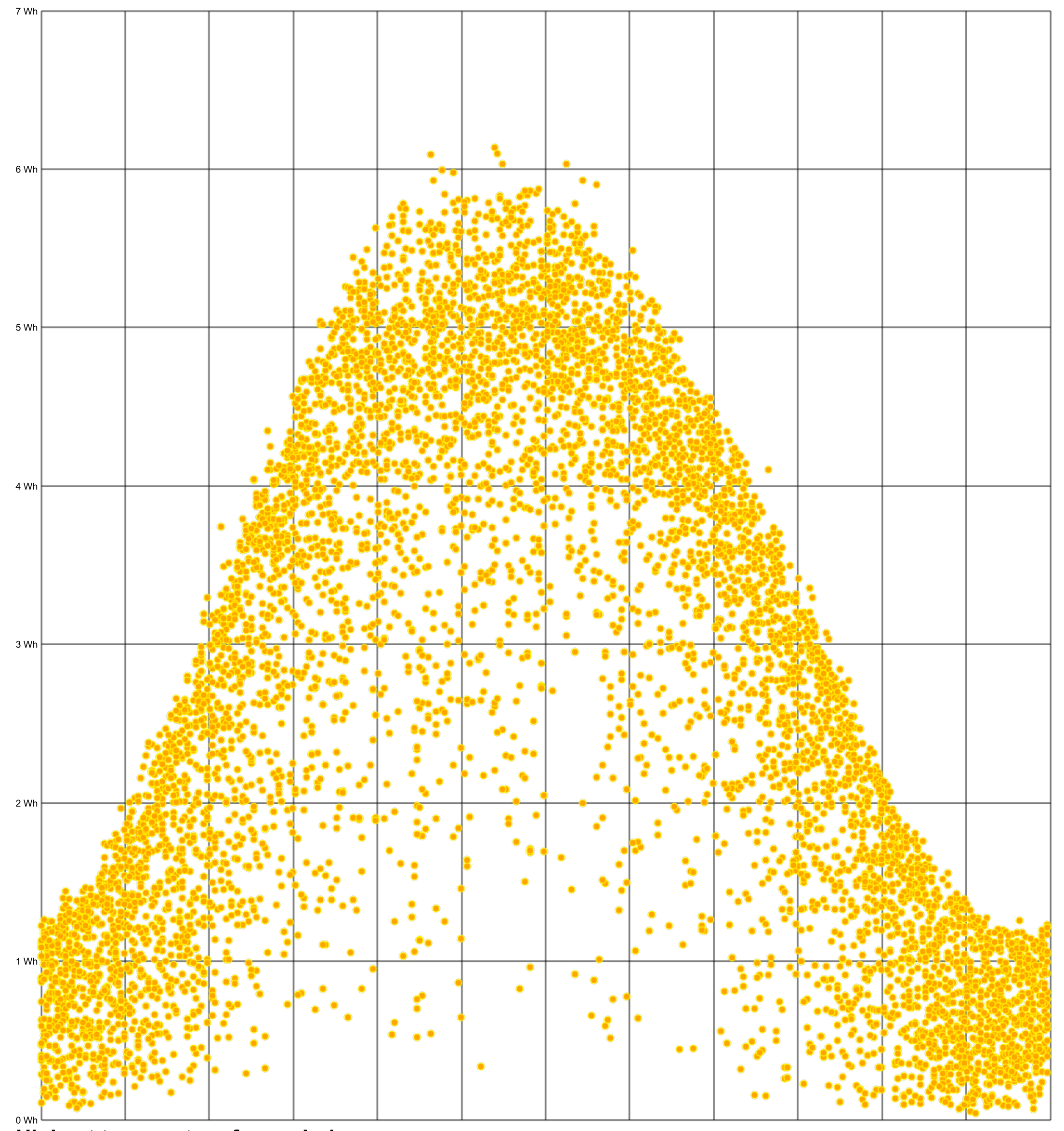 Daily solar output in Budapest from 2005 through the end of 2023.
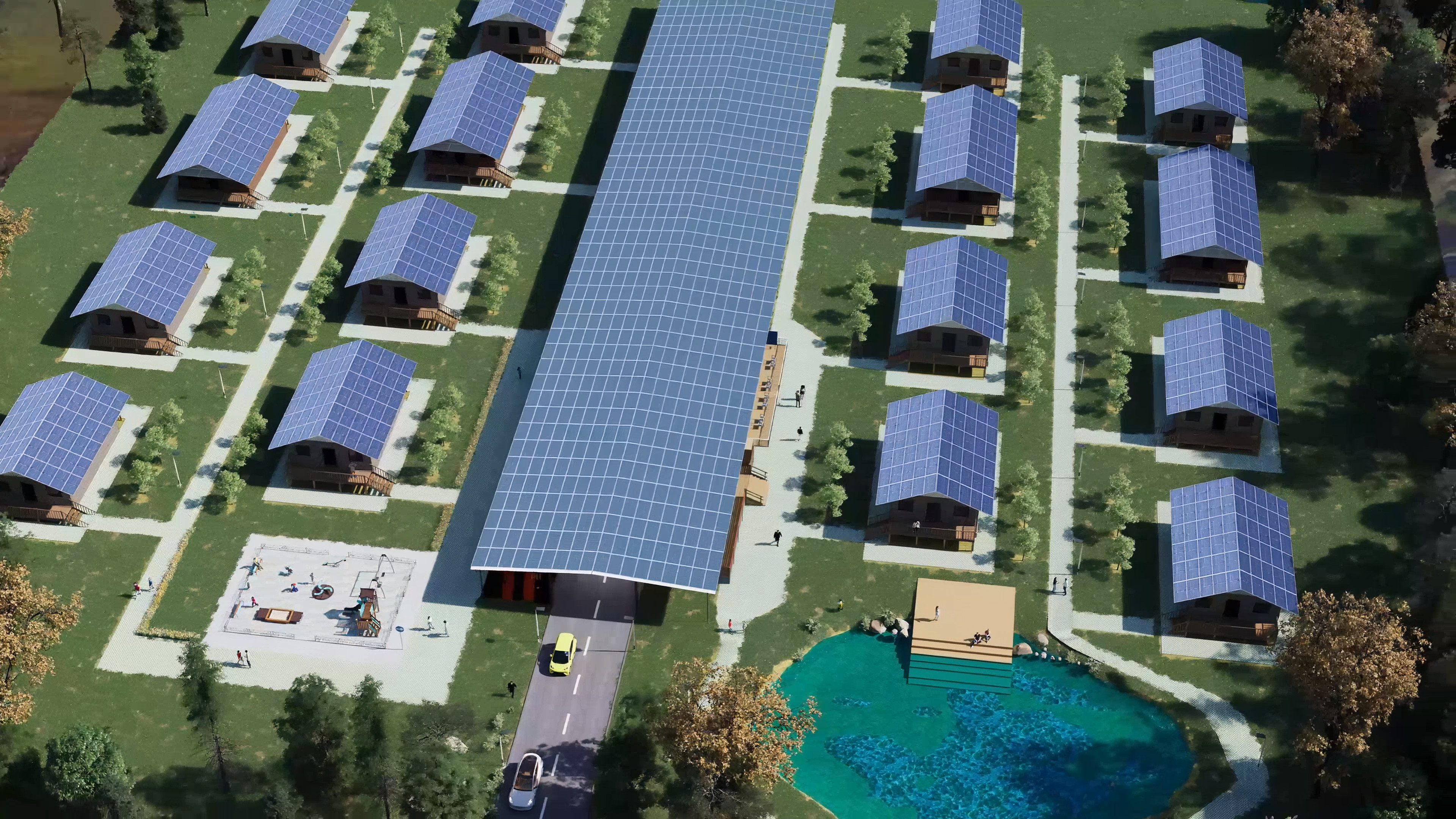 The result of these considerations is an “energy-optimized community”: 16 houses per hectare, 1.34 MWp of photovoltaic capacity, and 4 MWh of battery storage to convert the solar power into 24-hour electricity.
20,000 new housing units per year in the form of such energy-optimized residential areas would equate to 1.67 GWp of photovoltaic capacity and 5 GWh of battery storage. Replacing the Paks nuclear power plant during the summer months would therefore realistically be achievable in just under 7 years once mass production begins.
The result of these considerations is an “energy-optimized community”: 16 houses per hectare, 1.34 MWp of photovoltaic capacity, and 4 MWh of battery storage to convert the solar power into 24-hour electricity.
20,000 new housing units per year in the form of such energy-optimized residential areas would equate to 1.67 GWp of photovoltaic capacity and 5 GWh of battery storage. Replacing the Paks nuclear power plant during the summer months would therefore realistically be achievable in just under 7 years once mass production begins.