Producing Our Own Food
What should be done if the working population can no longer support the non-working population?
The only solution is a drastic reduction in housing, energy, and food costs.
The only true statement in the trashy novel *The Limits to Growth*: We cannot sustainably support a population of over 8 billion people with the technology available in 1972.
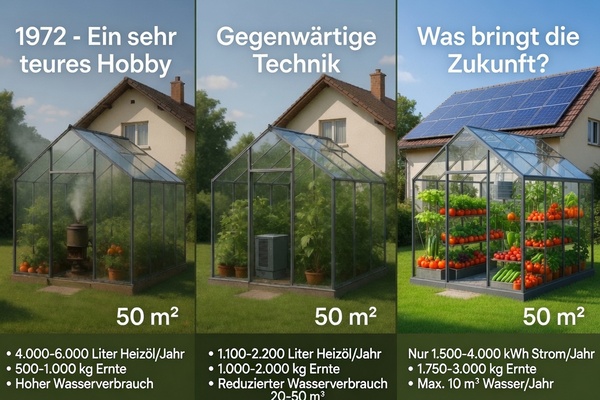
Let's take a look at one aspect of technology in 1972, today, and in the near future. To put it in a personal context: a 50 m² glasshouse next to a single-family home.
|
A Very Expensive Hobby, 1972
|
In 1972, greenhouses were made of single-pane glass or plastic sheeting. Double glazing was rare and far from today’s standards: only u=2.5 to 3.5 W/m²/K. Today, triple-pane glazing achieves a U-value of 0.6 W/m²/K. Greenhouses were heated with oil or gas. Back then, a 50 m² greenhouse in Austria consumed 4,000 to 6,000 liters of heating oil.
With a typical mix of fruits and vegetables, the harvest amounted to 500 to 1,000 kg per year. That means 4 to 12 liters of heating oil per 1 kg of fruit or vegetables.
Water consumption ranged from 75 to 150 cubic meters per year. This isn't a problem in water-rich Austria, but it severely limits the technology's use in arid regions.
Better thermal insulation reduces energy consumption. With heating oil, consumption would be only 1,100 to 2,200 liters per year. In return, however, the yield doubles to 1,000 to 2,000 kg per year. Is this what the author of “Faktor 4” meant when he refused to review my book “Calculation ERROR” in 2013 because he is incompetent? That is clearly “Faktor 4”: consumption halved, yield doubled. But that is nowhere near enough.
Water consumption dropped to 20 to 50 cubic meters per year. This makes it much easier in dry areas.
|
What does the future hold?
|
Vacuum glass enables previously unattainable thermal insulation values in a greenhouse. The glass provides better thermal insulation than exterior walls, as required by the 1995 Thermal Insulation Act. Prices will soon reach a level that is very attractive for greenhouse operations.
Ventilation systems with heat and moisture recovery from exhaust air further improve energy efficiency. This ventilation system is sufficient for a 50 m² greenhouse. Only in extremely dry regions will one resort to a significantly reduced air exchange rate and DAC (Direct Air Capture) of CO2 to drastically reduce water consumption.
I just wrote about the EWG - Energy, Heat, Garage project. The target audience is home renovations, but even after renovation, such old houses still have significant heating needs. The goal was to find the cheapest solution. I now have that solution, and it also enables an even more cost-effective way to heat greenhouses.
Initial estimates range from 1,500 kWh to 4,000 kWh of electricity per year. The harvest increases to 1,750 kg to 3,000 kg per year. Water consumption is even lower, at no more than 10 m³/a.
|
The Financial Viability of the Non-Working Population
|
Our society is changing. We must be prepared for dramatic changes and discuss all possibilities. In 2004, I launched the “Politics” subdomain of PEGE under the motto, “We’re heading full speed toward a wall—I have to wake the politicians up.” Unfortunately, there is a total refusal to engage in discussion here. In 2009, I wrote hard-hitting articles about the collapse of the German auto industry. What do we do about the huge number of unemployed people? What do we do when the working population can no longer support the non-working population?
The only way to solve this problem is through drastic cost reductions in housing, energy, and food. GEMINI next Generation tackles all three components at once. Did Henry Ford become poor because he sold cheap cars? Did Ingvar Kamprad (IKEA) become poor because of his cheap furniture? Did the Albrecht brothers (ALDI) become poor by selling cheap food? There’s another company founder who drastically reduced the cost of transport to Earth’s orbit. He didn’t become poor as a result—instead, he became the first trillionaire.
The mindset of all pseudo-innovative forces in Germany: We rip people off as much as we possibly can, and because customers can’t afford it, we demand government subsidies to support our customers. Example: heat pump. To these pseudo-innovative forces, I am a threat to their entire ecosystem of rip-offs and subsidies, which they have built up over decades of lobbying.
|
Who are we? Our shareholders
|
Who are we? Our shareholders.” I ask all existing shareholders—and, hopefully, many new ones soon—to submit contributions like this.
So far, only 2% of our shareholders have become shareholders themselves by referring new shareholders. That number should increase significantly in the future. The offer is 10% of the purchased shares for a direct referral and 5% for an assist. I understand the term “assist” in the same way as in soccer: whoever passes the ball to the goal scorer has made an assist. |