Import and Export of Energy
How can Germany be supplied with solar power and imported methanol? There is a wide range of combinations of domestic production and imports with a power generation cost of less than 9.2 cents per kWh.
The last newsletter focused on a 24/7 power supply for Germany. With a price of 10 cents/kWh HHV, there were only minimal imports of methanol. The simulation used a sales-to-purchase ratio of 40%. That is, purchase price 10 cents, sales price 4 cents/kWh HHV.
In many regions, the optimal cost is achieved by selling methanol at the current electricity price—even at just 4 cents/kWh (upper heating value). What if this methanol were available to Germany at 7 cents/kWh after factoring in 3 cents in transportation costs?
Do we even need a costly energy transition? Should we just import it? Generating electricity from methanol at 7 cents/kWh (upper heating value) with 54% efficiency results in fuel costs alone of 13 cents/kWh. On top of that, there are maintenance and depreciation costs for the power plants and batteries. Quite simply, it’s far too expensive. To produce 900 TWh of electricity, 1,667 TWh of methanol would have to be imported. Given such pressure on demand, is 7 cents/kWh HHV even feasible?
|
Germany with solar power and methanol imports
|
There is a wide range of self-generation/import combinations with a power generation cost of less than 9.2 cents per kWh.
| E-settlements km²
| 13,699
| 10,274
| 8,219
| 6,849
|
| Photovoltaics GW
| 1,852
| 1,389
| 1,111
| 926
|
| cents per kWh
| 9:15
| 9.01
| 9.11
| 9.18
|
| Battery storage (GWh)
| 3,425
| 2,433
| 2,055
| 2,055
|
| Power to GW
| 96
| 72
| 58
| 48
|
| Imported calorific value (TWh/year)
| 230
| 411
| 579
| 663
|
| Investment in Germany G€
| 946
| 725
| 592
| 517
|
|
What became of the 2021 study "Germany 100% Solar"?
|
This approach was based on a completely different system philosophy: Every watt of solar power must be utilized! This required 4,000 GWh of battery storage and 180 GW of power-to-methane capacity.
Even back then, I wondered: wouldn’t 160 GW of power-to-methane be cheaper? There would be only a slight loss in methane production, but in return, we’d have 20 GW less in power-to-methane and grid expansion.
The investment was calculated using the prices specified in the new scenario.
| Study
| 1. column above
| 2. column above
| 2021 study
|
| Photovoltaics GW
| 1,852
| 1,389
| 1,400
|
| Battery GWh
| 3,425
| 2,433
| 4,000
|
| Power to GW
| 96
| 72
| 180
|
| Imported calorific value (TWh/year)
| 230
| 411
| 245
|
| Investment in Germany G€
| 946
| 725
| 1,018
|
|
Fossil fuel consumption in Germany
|
| Year
| 1995
| 2005
| 2015
| 2025
|
| Lignite TWh
| 482
| 443
| 435
| 210
|
| Coal TWh
| 572
| 502
| 477
| 210
|
| Natural gas (TWh)
| 778
| 903
| 778
| 720
|
| Oil TWh
| 1,580
| 1,435
| 1,242
| 1,045
|
| Total TWh
| 3,412
| 3,283
| 2,932
| 2,285
|
The 230 TWh/a to 663 TWh/a of methanol imported from solar power is quite low compared to this use of fossil fuels.
|
New network fees against behavior that benefits the system
|
Huge amounts of solar power are flooding the grid. Spot market prices are turning negative. At this time, the best way to support the grid is to consume as much electricity as possible. Supply and demand determine the price. If 2 million electric cars are charging at 11 kW, that amounts to 22 GW. On a sunny Sunday with low demand, this is a very significant amount.
However, some network operators are now taking strong action against precisely this behavior that benefits the system: Network charges are largely determined by the highest 1⁄4-hour consumption in a month. In Austria, this applies in Upper Austria, Lower Austria, Burgenland, and Styria. In many EU countries, this system has already been introduced or is in the planning stages.
This has a massive impact on electric cars. What’s the point of buying 1,000 kWh at 10 cents/kWh cheaper on the spot market if you’re then hit with an extra €1,000 a year in grid fees? All this fuss about “We’re promoting electric cars,” but in reality they’re coming up with massive new ways to rip people off.
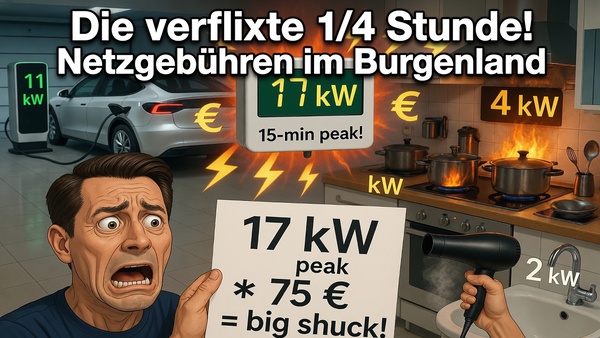 17 kW × €75 = €1,275 annual grid fee in Burgenland. Lower Austria is also extremely high at 17 kW × €56 = €952. What can be done?
My electricity consumption of 5,006 kWh in 2025 actually averages out to just 572 watts. If I were to buy electricity only during the 8 cheapest hours of the day, it would still be less than 2 kW.
If the average of all monthly 1⁄4-hour peak loads were only 2 kW instead of 12 kW, Burgenland would have saved €750 in grid fees, and Lower Austria would still have saved €560 in grid fees.
More on that next Sunday.
17 kW × €75 = €1,275 annual grid fee in Burgenland. Lower Austria is also extremely high at 17 kW × €56 = €952. What can be done?
My electricity consumption of 5,006 kWh in 2025 actually averages out to just 572 watts. If I were to buy electricity only during the 8 cheapest hours of the day, it would still be less than 2 kW.
If the average of all monthly 1⁄4-hour peak loads were only 2 kW instead of 12 kW, Burgenland would have saved €750 in grid fees, and Lower Austria would still have saved €560 in grid fees.
More on that next Sunday.
|
GEMINI next Generation Zrt. registered
|
I went to Budapest on Tuesday to open a bank account. On Thursday, I had my first meeting with HIPA. It felt very different from my meetings with various Austrian agencies.
The focus now is on improving our capital base. Next up is the €400,000 needed for the prototype.
Here's how you can get involved
|
Who are we? Our shareholders
|
Who are we? Our shareholders.” I ask all existing shareholders—and, hopefully, many new ones soon—to submit contributions of this kind.
So far, only 2% of our shareholders have become shareholders themselves by referring new shareholders. That figure should increase significantly in the future. The offer is 10% of the purchased shares for a direct referral and 5% for an assist. I understand the term “assist” in the same way as in soccer: whoever passes the ball to the goal scorer has made an assist. |
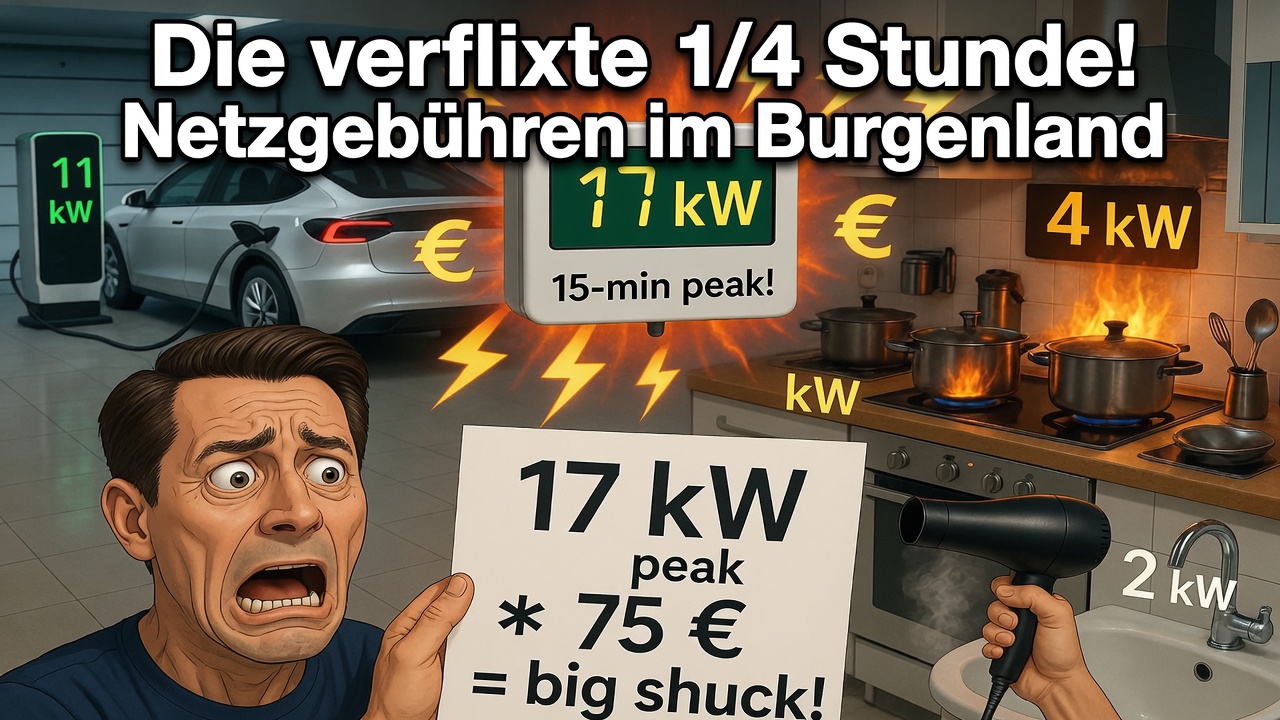 17 kW × €75 = €1,275 annual grid fee in Burgenland. Lower Austria is also extremely high at 17 kW × €56 = €952. What can be done?
My electricity consumption of 5,006 kWh in 2025 actually averages out to just 572 watts. If I were to buy electricity only during the 8 cheapest hours of the day, it would still be less than 2 kW.
If the average of all monthly 1⁄4-hour peak loads were only 2 kW instead of 12 kW, Burgenland would have saved €750 in grid fees, and Lower Austria would still have saved €560 in grid fees.
More on that next Sunday.
17 kW × €75 = €1,275 annual grid fee in Burgenland. Lower Austria is also extremely high at 17 kW × €56 = €952. What can be done?
My electricity consumption of 5,006 kWh in 2025 actually averages out to just 572 watts. If I were to buy electricity only during the 8 cheapest hours of the day, it would still be less than 2 kW.
If the average of all monthly 1⁄4-hour peak loads were only 2 kW instead of 12 kW, Burgenland would have saved €750 in grid fees, and Lower Austria would still have saved €560 in grid fees.
More on that next Sunday.