IPCC cancels disaster scenarios
This is due to the price development of photovoltaics and batteries. Prices have fallen so dramatically that scenarios that are heavily fossil-oriented have become completely uneconomical.
|
Development of the global photovoltaic market
|
How did it come about that the IPCC had to cancel the worst catastrophe scenarios? How did this misjudgement come about? Let's take a look at the EEG from 2004 with a 5% annual reduction in the feed-in tariff. The basic assumption was that a new up-and-coming industry would produce 20% cheaper every time the global market doubled.
In 2004, the EEG remuneration started at 57.4 cents/kWh. If this had continued until 2026, the EEG tariff would currently be 18.6 cents/kWh.
However, the degression of feed-in tariffs had to be significantly accelerated as early as 2007. Politik.pege.org reported on this.
In 1995, I was head of marketing and application technology at the start-up Ökoenergie Transkontakt. How do you convince investors? With a realistic forecast about the photovoltaic world market of the future.
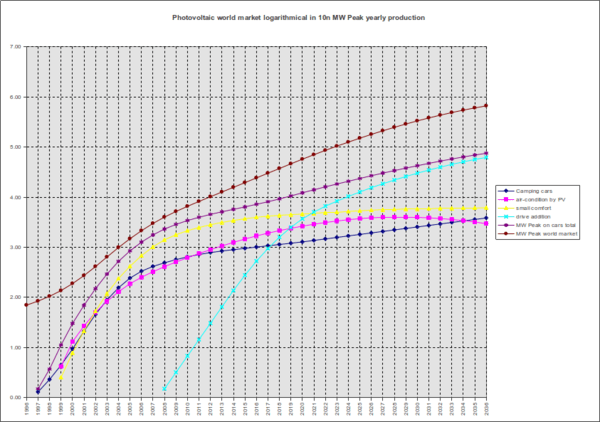 It is by far the most radical forecast from this period. Other forecasts from that time were 90% to 99% lower. Or vice versa, my forecast was 10 to 100 times higher than the others.
But even my forecast for 2026 was much too low at 178 GW. It will be 4 times more. So my 1996 forecast for 2026 was 1:4 wrong, the others 1:40 to 1:400.
It is by far the most radical forecast from this period. Other forecasts from that time were 90% to 99% lower. Or vice versa, my forecast was 10 to 100 times higher than the others.
But even my forecast for 2026 was much too low at 178 GW. It will be 4 times more. So my 1996 forecast for 2026 was 1:4 wrong, the others 1:40 to 1:400.
|
Development of price and raw materials for batteries
|
In 2012 I wrote in my 2nd book "Calculation ERROR" on page 395 4,000 GWh batteries for the German electricity system for € 800 billion. 200 € per kWh battery. I certainly knew that a new emerging industry produces 20% cheaper every time the world market doubles. The only question is how long? Oil was also once an emerging industry and from 1859 to 1893 there were great price reductions, which then stopped. When will this 1893 be for photovoltaics and batteries? I'd rather be too cautious with the forecast.
For decades, I have followed the development of lithium reserves with great interest every year. On this page you can also study how the situation was estimated in 1996. I used it to recalculate every year how many kWh of lithium batteries could be produced per person.
I even suspected that Saudi Arabia could mine the 0.18 ppm lithium from seawater in the future using cheap solar power.
Then came the redemptive news: sodium batteries. There are 10,500 ppm sodium in seawater.
My current simulations are based on a €40/kWh battery. In 2012, 30 million tons of mineable lithium were assumed; in 2026, 120 million tons and practically unlimited sodium.
This makes it understandable why I calculated €200/kWh battery in 2012. However, it is completely incomprehensible why scientists at the Fraunhofer Institute calculated a battery cost of €1,000/kWh in 2020. I spoke to one of the authors of this study on the phone.
Here to the video with my review.
I call it total scientific incompetence and the inability to collaborate with scientists from other disciplines. One question on Alibaba alone would have shown that one zero is too many at that price.
This is due to the price development of photovoltaics and batteries. Prices have fallen so dramatically that the massive use of fossil fuels, as in the deleted scenarios, has become completely uneconomical.
Fossil dirt is simply losing the price war.
|
Contribute to eliminating further IPCC scenarios
|
Forward-looking governments, courageous entrepreneurs and hard-working engineers have brought about the deletion of the IPCC catastrophe scenarios.
The cost savings from the GEMINI next generation house can make a decisive contribution to eliminating further unfavorable IPCC scenarios in mass production. Contribute to this!
|
Between application and registration
|
The registration took place 9 days ago on Friday with a lawyer in Budapest. The share capital has been credited to the foundation account. The HUF 105,000 registration fee has been transferred to the Hungarian authorities.
Now it's all about improving the capital resources. Next up is the €400,000 for the prototype.
Here is our offer to join in
|
Who are we? Our shareholders
|
Who are we? Our shareholders." I ask all old and hopefully soon numerous new shareholders for contributions of this kind.
|
Recruiting new shareholders
|
So far, only 2% of our shareholders have become shareholders themselves through new shareholder referrals. This should increase significantly in the future. The offer is 10% of the shares purchased for a direct referral and 5% for an assist. I understand the term assist in the same way as in soccer: whoever passes the ball to the scorer has made an assist. |