Chaos on the spot market - the consequences of the do not need batteries sabotage
A conspicuous army of civil servants who imposed the bottle caps on us were unable to come up with a sensible electricity market design.
 Yesterday Saturday at 13:30 a look at the just published prices for Sunday, April 26, 2026. NO! Stop charging the car immediately, but it's already too late, I only charge to 100% before long journeys, otherwise only to 83%. What a waste of money. I've just charged for MINUS 20 cents/kWh, but tomorrow on Sunday it will go down to MINUS 48 cents.
Especially to motivate electricity consumption between 10:00 and 16:00, the grid charges are lower in Austria from April to September. The handling fee from Spottyenergie must also be paid. Despite all this, you can reduce your electricity bill by consuming less than MINUS 15 cents/kWh.
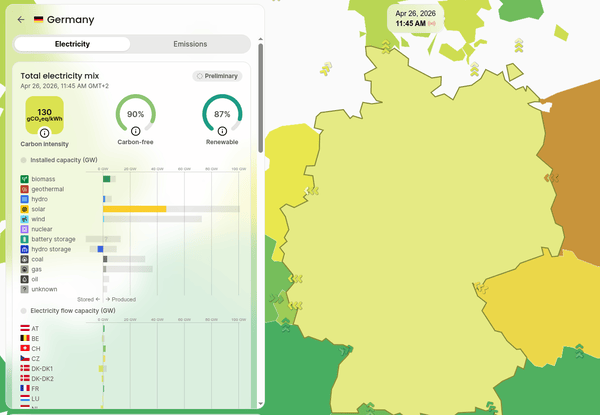
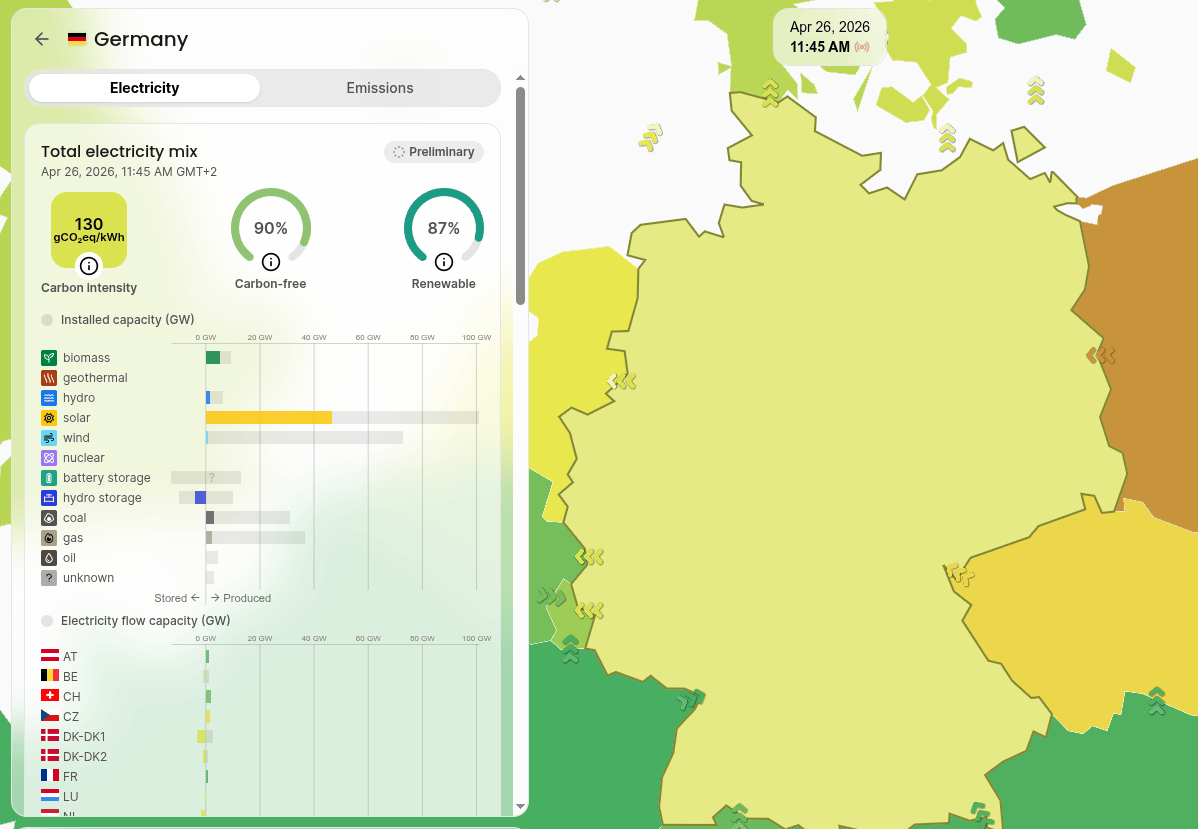
Why is there 5.08 GW from biomass? Why is electricity from biomass extremely highly subsidized, despite 230 g C02eq/kWh? Why are 3.02 GW of coal-fired power plants in operation? Why are 2.38 GW of gas-fired power plants in operation?
Why is 1.18 GW imported from Austria, 1.78 GW from Switzerland, 1.5 GW from the Czech Republic and 0.9 GW from France?
All this at a 1⁄4 hour spot market price of -21.34 cents/kWh in Austria.
It is a grotesque deformation of a market. When a computer game is designed, extensive tests are carried out to see how the game's algorithm can be tricked. This is to avoid grotesque situations. Here, these tests have obviously been omitted. A standard procedure that any small software manufacturer with 5 employees can master has been omitted in the European electricity market design.
A conspicuous army of civil servants who imposed the bottle caps on us were unable to come up with a sensible electricity market design.
Yesterday Saturday at 13:30 a look at the just published prices for Sunday, April 26, 2026. NO! Stop charging the car immediately, but it's already too late, I only charge to 100% before long journeys, otherwise only to 83%. What a waste of money. I've just charged for MINUS 20 cents/kWh, but tomorrow on Sunday it will go down to MINUS 48 cents.
Especially to motivate electricity consumption between 10:00 and 16:00, the grid charges are lower in Austria from April to September. The handling fee from Spottyenergie must also be paid. Despite all this, you can reduce your electricity bill by consuming less than MINUS 15 cents/kWh.
Why is there 5.08 GW from biomass? Why is electricity from biomass extremely highly subsidized, despite 230 g C02eq/kWh? Why are 3.02 GW of coal-fired power plants in operation? Why are 2.38 GW of gas-fired power plants in operation?
Why is 1.18 GW imported from Austria, 1.78 GW from Switzerland, 1.5 GW from the Czech Republic and 0.9 GW from France?
All this at a 1⁄4 hour spot market price of -21.34 cents/kWh in Austria.
It is a grotesque deformation of a market. When a computer game is designed, extensive tests are carried out to see how the game's algorithm can be tricked. This is to avoid grotesque situations. Here, these tests have obviously been omitted. A standard procedure that any small software manufacturer with 5 employees can master has been omitted in the European electricity market design.
A conspicuous army of civil servants who imposed the bottle caps on us were unable to come up with a sensible electricity market design.
|
Who feeds into the grid in Germany today?
|
Legal basis: Section 51 EEG and exceptions (scientific-systematic analysis)
Since the 2023/2025 amendments (including the Solar Peak Act), the EEG has stipulated that the value to be applied (i.e. the basis for the market premium or fixed remuneration) is set to zero in the event of negative spot prices - for new installations from the first negative quarter of an hour or after short grace periods (depending on the commissioning date and installation size). The aim is a stronger market orientation: plants are to be curtailed when there is a surplus in order to reduce grid stability and EEG costs. However, the non-remunerated periods often extend the funding period (compensation).
However, exemptions and grandfathering mean that not all installations are affected:
Small photovoltaic roof systems (
Older existing installations in the fixed tariff (not or only partially in direct marketing/market premium): These continue to run, as the grid operator pays the fixed remuneration regardless of the market. The TSO bears the market risk (may sell at negative prices).
Biogas plants (often CHP): Technically difficult to control flexibly (process heat, fermentation process). They often run continuously, even at negative prices. Special rules apply in some cases (e.g. only dropped at very low prices ≤ 2 ct/kWh). Remuneration is maintained as they are considered "system-supporting".
Hydropower (run-of-river based): Similar to biomass, often cannot be regulated or can only be regulated to a limited extent; older plants with fixed remuneration continue to feed in.
In contrast, large modern wind and ground-mounted PV systems (> 100 kW, direct marketing) generally lose the market premium when prices are negative (after a waiting period) and often regulate down - or only feed in if the negative costs are more than compensated for by the premium (which is rarely the case with "massively" negative prices).
|
Refining flutter current to 24-current
|
Batteries are needed to convert flicker power into 24-phase power. The German energy transition would have needed batteries at the latest at 70 GW of photovoltaic expansion. Currently, 120 GWp of photovoltaics are causing chaos on the spot market instead of making a positive contribution to the energy transition. On a sunny summer day, these 120 GWp of photovoltaics can generate 600 GWh, on a very sunny summer day 720 GWh.
That is 25 to 30 GW evenly distributed throughout the day. This would require 360 GWh of batteries. Ideally placed directly at the power generator before the electricity is fed into the grid. Even at €100/kWh, only €36 billion. A real bargain compared to the current insane system:
- lower grid expansion costs, the grid connection for photovoltaics is limited to 30% of peak output
- no negative electricity prices financed by taxpayers via the EEG levy
- Much lower redispatch costs
- No standby power plants for solar and wind forecast errors
- No inefficient operation of thermal power plants due to rapid load changes
- a single power outage like the one in Spain in 2025 would cost the German economy €6 to 13 billion
Down to MINUS 48 cents/kWh is a disaster day. A showcase of a serious system failure. Nevertheless, Renewable Energy Austria is posting "April 26th Renewable Energy Day" on Linkedin today.
|
5 million HUF share capital is the minimum
|
15,152 € in the account for the share capital. Ideally, the company should be founded with more than € 24,000 in share capital. The foundation should take place in April 2026. The search for investors for the prototype will only continue after the successful establishment of the Zrt. (unlisted public limited company in Hungary). Finding €400,000 requires other methods than for €24,000.
The prototype will most likely be realized on the property of Mr. Kamml, which is located directly south of ADEG in Unken. The proximity to Salzburg is a locational advantage for the planned invitation of industrialists and politicians from all over the world.
Every small contribution counts towards the rapid realization of the share capital. At the moment, multiples of € 120, a block of 30 shares for the buyer. 40 × € 600 is also € 24,000. Here to the share price development.
This far-reaching solution concept must not fail due to the total ignorance of investors in German-speaking countries. Perhaps I would have found an investor in the German-speaking world for "The self-sufficient survival house for the rich, only one million each". That would have fitted in perfectly with the local rip-off mentality. But that's not me.
Here is our offer to join in
|
Who are we? Our shareholders
|
Who are we? Our shareholders." I ask all old and hopefully soon numerous new shareholders for contributions of this kind.
|
Recruiting new shareholders
|
So far, only 2% of our shareholders have become shareholders themselves through new shareholder referrals. This should increase significantly in the future. The offer is 10% of the shares purchased for a direct referral and 5% for an assist. I understand the term assist in the same way as in soccer: whoever passes the ball to the scorer has made an assist. |
 Yesterday Saturday at 13:30 a look at the just published prices for Sunday, April 26, 2026. NO! Stop charging the car immediately, but it's already too late, I only charge to 100% before long journeys, otherwise only to 83%. What a waste of money. I've just charged for MINUS 20 cents/kWh, but tomorrow on Sunday it will go down to MINUS 48 cents.
Especially to motivate electricity consumption between 10:00 and 16:00, the grid charges are lower in Austria from April to September. The handling fee from Spottyenergie must also be paid. Despite all this, you can reduce your electricity bill by consuming less than MINUS 15 cents/kWh.
Yesterday Saturday at 13:30 a look at the just published prices for Sunday, April 26, 2026. NO! Stop charging the car immediately, but it's already too late, I only charge to 100% before long journeys, otherwise only to 83%. What a waste of money. I've just charged for MINUS 20 cents/kWh, but tomorrow on Sunday it will go down to MINUS 48 cents.
Especially to motivate electricity consumption between 10:00 and 16:00, the grid charges are lower in Austria from April to September. The handling fee from Spottyenergie must also be paid. Despite all this, you can reduce your electricity bill by consuming less than MINUS 15 cents/kWh.