Failure in strategic issues
Running cars on cheap energy? The car industry has as much understanding of this strategic question as a primary school pupil has of a differential equation.
The widespread use of new technology by systematically reducing production costs. Henry Ford is a prime example: producing cars so cheaply that even ordinary workers can afford one.
From a luxury for a few to a matter of course for all. There are two components to the price of a car: purchase price and energy. What good is it if a Tata Nano only costs €2,500 if the gasoline for 200,000 km costs €12,500 - 10,000 liters at €1.25?
Wouldn't €5,000 car and €2,000 electricity be much cheaper - 20,000 kWh at 10 cents/kWh? Nothing is more alien to a premium manufacturer than such a thought. Whoever buys a €100,000 premium car still has the money for the fuel? 300,000 km, 36,000 liters at €1.50. 54,000 is also a lot of money. Even for those who drive a €100,000 car.
The cheap mass production of cars has been mastered, now it's about the second component: the energy for it. There is only one way to do this: electricity instead of oil. This is crucial for poor countries whose development has been halted by oil imports: Catastrophic trade deficit caused by oil imports.
That would have been the big strategic issue for the car industry: Cars that can run on cheap electricity. The established car manufacturers only ever saw themselves as car manufacturers: we make cars, that's our business, oil production, oil tankers, oil pipelines, refineries and filling stations are a completely different business.
In stark contrast: the Tesla Super Charger network and BYD are now building extremely fast chargers with a charging capacity of over 1 MW. Both manufacturers also offer photovoltaics and electricity storage. NIO builds battery exchange stations.
These issues were probably far too high on the agenda for the managers of the established car companies. Instead, they wasted decades on “How do I build a diesel engine with twice the power but 10% less consumption, which always switches on the exhaust gas purification when it is on a test bench”.
They understood as much about this strategic issue as a primary school pupil understands a differential equation. They were concerned with simple things: how can you use a nonsensical formula for measuring the consumption of plug-in hybrids to trick the EU regulations on fleet consumption? Simply kindergarten.
This was the defining topic of German car manufacturers at the IAA 2015: We know exactly how many Wh of battery you need to install in a plug-in hybrid to achieve a standard consumption of 50 g CO2/km. That's enough, no more Wh of battery! An extreme deterioration compared to the Opel Ampera from 2011. Here are the values from Spritmonitor.de on April 18, 2026:
This is the extreme deterioration in just 4 years, because it was not the customer who counted, but only the manipulated fleet consumption formula.
|
The strategic topic of the home ownership industry
|
Established car companies are something with hundreds of thousands of employees. Companies in the home ownership industry are 2 to 3 orders of magnitude smaller. If the established car industry has not managed to hire managers with vision, how can the home industry?
The home ownership industry in the German-speaking world simply expects to be completely wiped out in the next few decades. People rejoice when a competitor goes bankrupt: Yay, their 5% market share is now ours!
Similar to a car, a house has two components: production and energy. The car was about switching to cheaper energy, the house is about switching from energy consumer to energy producer.
There the simple-minded attitude “We produce cars", here the simple-minded attitude “We produce houses”. Not the slightest approach to “We make houses the most important component of an energy transition".
Elon Musk had US$ 176 million from the sale of PayPal. Wang Chuanfu, the founder of BYD, borrowed US$ 300,000 from friends in 1995. Both invested well.
|
Bosch shows the consequences
|
In recent years, Bosch has attracted my attention several times with negative statements about electric cars. Losses now show the consequences of not understanding a strategic problem.
|
Unique form of presentation of the solar yield
|
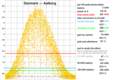
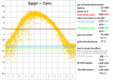
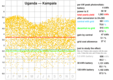
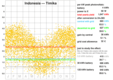
April 2024 I wrote the software for the simulation of 24×365 electricity with photovoltaics. The distribution of solar yield for each day of the year. The X-axis shows each day of the year, the Y-axis shows 16 yellow dots for the solar yield of that day in the year 2005 to 2020. With the representation you can see at a glance how difficult it is to make 24×365 electricity from the daily solar yield.
I have been working intensively with solar power since 1991, why have I never come across this form of presentation before? I asked Grok about it. It can't be true that I created an innovative display form in 2024.
You can tackle a problem with all its difficulties. This graphic illustrates all these difficulties in an easily understandable way.
You can pretend to tackle a problem. Then you will never publish such a graphic.
|
YouTube recommendation of the week
|
Why did the Roman Empire never industrialize?
It provides insights into the deindustrialization of Germany.
|
5 million HUF share capital is the minimum
|
14,552 € in the account for the share capital. For several newsletters I wrote: Fortunately, that's HUF and only €12,778.38. The minimum share capital at today's exchange rate is €13,769.89. After the election, the HUF jumped upwards.
Ideally, the company should be founded with more than € 24,000 in share capital. The foundation should take place in April 2026. The search for investors for the prototype will only continue after the successful establishment of Zrt. (unlisted public limited company in Hungary). Finding €400,000 requires other methods than for €24,000.
The prototype will most likely be realized on the property of Mr. Kamml, which is located directly south of ADEG in Unken. The proximity to Salzburg is a locational advantage for the planned invitation of industrialists and politicians from all over the world.
Every small contribution counts towards the rapid realization of the share capital. At the moment, multiples of € 120, a block of 30 shares for the buyer. 40 × € 600 is also € 24,000. Here to the share price development.
This far-reaching solution concept must not fail due to the total ignorance of investors in German-speaking countries. Perhaps I would have found an investor in the German-speaking world for “The self-sufficient survival house for the rich, only one million each”. That would have fitted in perfectly with the local rip-off mentality. But that's not me.
Here is our offer to join in
|
Who are we? Our shareholders
|
Who are we? Our shareholders.” I ask all old and hopefully soon numerous new shareholders for contributions of this kind.
|
Recruiting new shareholders
|
So far, only 2% of our shareholders have become shareholders themselves through new shareholder referrals. This should increase significantly in the future. The offer is 10% of the shares purchased for a direct referral and 5% for an assist. I understand the term assist in the same way as in soccer: whoever passes the ball to the scorer has made an assist. |