Between the fronts: the hurray fans and the skeptics
There are the fans of renewable energy. They spread extremely false cheers about renewable energy. Hooray for 60% renewable energy! But what has 60% been achieved? Electricity. Total energy consumption is called primary energy consumption and it is still measured in fires. Germany made 2.928 TWh of fires in 2024.
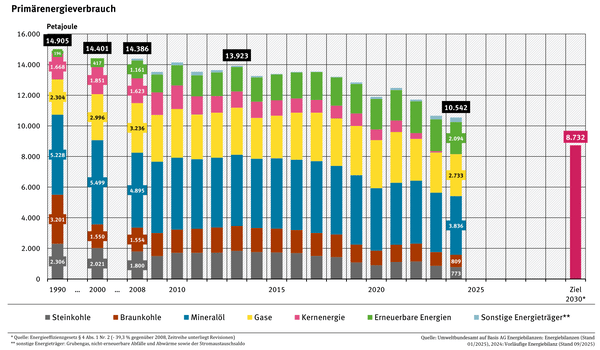 The 10,542 petajoules can be converted by dividing them by 3,600 (1 joule is one watt-second, i.e. one watt for one second, as the name "watt-hour" suggests, one watt for one hour): 2.928 TWh. The 2,094 PJ of renewable energy are therefore 582 TWh. But that's a mixture of fires and electricity from solar, wind and hydropower.
A considerable part of this is making fires with biomass. The 26,000 km² of fields for growing corn, rapeseed and sunflowers, just for burning. All the wood that is burned and drives neighbors to despair. This means that a considerable part of these 582 TWh is gross nonsense that should be stopped.
The 10,542 petajoules can be converted by dividing them by 3,600 (1 joule is one watt-second, i.e. one watt for one second, as the name "watt-hour" suggests, one watt for one hour): 2.928 TWh. The 2,094 PJ of renewable energy are therefore 582 TWh. But that's a mixture of fires and electricity from solar, wind and hydropower.
A considerable part of this is making fires with biomass. The 26,000 km² of fields for growing corn, rapeseed and sunflowers, just for burning. All the wood that is burned and drives neighbors to despair. This means that a considerable part of these 582 TWh is gross nonsense that should be stopped.
|
Replacing thermal energy with electricity
|
There is a replacement factor with electricity for every use of heat. If I now drive with 15 kWh of electricity per 100 km after charging losses and I used to consume 4.35 liters in the Dacia Lodgy, the calorific value of diesel is 10.5 kWh per liter, then this is around 1 kWh of electricity for 3 kWh of thermal energy from diesel.
This is far less favorable for a cement factory: 1 kWh of electricity instead of 1.6 kWh of heat. Steel production using hydrogen instead of carbon to reduce the ore means 4 kWh of electricity per kg of steel. The most extreme example is the production of fertilizers: 9 kWh of electricity for 1 kg of urea. In the other direction, there is the excellent new building, where the heat pump turns 1 kWh of electricity into 6 kWh of heat.
|
From flutter electricity to 24×365 electricity
|
One photovoltaic system is sufficient for flutter power. To turn this into 24 kW of electricity, 3 kWh of batteries are required per kW of photovoltaics. An efficiency of over 90% can be assumed for batteries. The big challenge is then the conversion into 24×365 electricity. This would be possible with batteries if money were no object. Great, add 150 kWh of batteries per kW of PV, that gives a decent 24×365 conversion, with the flaw of 75 cents per kWh despite an assumption of only €40 per kWh of sodium batteries. Some sneaky enemies of renewable energy calculate this way, but they then take 400 € instead of 40 € per kWh battery.
Of course, it is much cheaper to stick with 3 kWh battery per kW peak photovoltaic and add power to methanol, a simple tank and a generator. In areas with an existing power grid, a central power to methanol plant and a gas power plant. Of course, the efficiency is pretty poor, but in the end it's only the result that counts: 9 cents/kWh in Salzburg instead of the 75 cents/kWh in the crazy battery simulation. In very sunny areas closer to the equator, even as little as 3 cents/kWh.
|
Conversion efficiency for 24×365 electricity
|
In very favorable areas, almost 70% of solar power can be converted to 24×365 electricity. Central Europe to Northern Europe is the opposite of a very favorable area. The area around Aalborg is certainly a top location for wind energy. Nevertheless, with different combinations of solar and wind energy, I do not get above 60% conversion efficiency for 24×365 electricity.
The hurray fans haven't even really realized the necessity of 24 electricity. A simple rule of thumb for Central Europe: in the beginning, 1 kW of photovoltaics is enough for 1,000 kWh more annual yield. This first phase in Germany is limited to 70 GW of photovoltaics, the many years' expansion target. Then comes the 24-current phase: now 1 kW of photovoltaics and 3 kWh of batteries must be added for 1,000 kWh more annual yield. The 24-current phase in Germany goes up to 300 GW of photovoltaics and 750 GWh of batteries.
Then comes the 24×365 conversion phase: for 1,000 kWh more annual yield of 24×365 electricity, 2 kW of photovoltaics, 6 kWh of batteries, 100 W of power to methanol and 30 liters of methanol tank must be added. As a rule of thumb for the costs: 24 electricity is cheaper due to
of the batteries is twice as expensive as flutter electricity, 24×365 electricity is five times as expensive as flutter electricity due to the conversion losses and the additional equipment required.
This is the dramatic difference between "Solar power is so cheap" and the title of my presentation at the CORP conference: "Cost optimization - the key to the energy transition and climate protection". We have to optimize the costs of the five times more expensive 24×365 electricity so that we can live and operate our industry with it. Not all industry, a fertilizer factory only works in the Sahara or a similarly sunny desert with 24 electricity. But cement and steel must be feasible.
How do you discuss this with a hurray we are at 60% renewable energy fan? Completely impossible, you're classified as an enemy after the first sentence.
How do you discuss this with a skeptic of renewable energy? After the first sentence, you get a "I've always known that the energy transition is nonsense".
How do you discuss this with a potential investor? After the first sentence comes "We've almost reached our goal with renewable energy, so I'm withdrawing from your project, it's simply no longer needed."
|
Grok and the German energy transition
|
Grok is excellent as a consultant, unless you ask about plans for the German energy transition. Suddenly nothing fits together. Precisely because the initial data is one crazy pile.
For example with hydrogen storage tanks. These only have 1⁄3 of the storage capacity with the same volume. How is summer/winter balancing supposed to work? Hydrogen is religiously revered, but due to a lack of sufficient storage capacity, hydrogen power plants are complete nonsense. Of course, new storage capacity can be expanded, but methanol is by far the cheapest, followed by methane and hydrogen, which is three times as expensive.
|
GEMINI - the perfect solution for a hidden problem
|
Elon Musk once said: "When a trend becomes visible, it's already too late". I was at "Bits and Pretzels" in Munich, MIA - Mission Innovation Austria, Slush Heilbronn, DENA Energiewende conference in Berlin. There were only people there who were chasing trends, but not a single one who looked at the solution to a systematically concealed problem. It's so obvious when you look at the figures, so incomprehensible if you're just a fanboy of the energy transition.
|
The planetary restoration mentality
|
Planetary cleanup back to 350 ppm CO2 means around 47,000 TWh of electricity to filter 1 ppm CO2 from the atmosphere and recycle it into carbon and oxygen. Who can afford that? Only a rich human race, 10 billion people in prosperity can do it. One million km² of energy-optimized settlement areas alone should contribute 150,000 TWh for the necessary electricity for world-wide prosperity and planetary restoration.
|
GEMINI next Generation AG will prove the contrary
|
It's not about whether the shares will be worth 100 times or 1000 times more in 20 years' time or whether they will only be worth a few cents. It's about the future of us all. Will there be a big showdown between eco-fascism and yesterday's fossils, or will it be possible to overcome the deep divisions in society and inspire supporters of both sides to work towards a great new goal?
Global prosperity and planetary restoration instead of saving, restricting, renouncing and climate catastrophe or peak oil and a little more climate catastrophe. Both sides must be convinced that they have no solution that is even remotely viable.
On the one hand, it must be shown that net-zero emissions are a completely inadequate target and that the goal must instead be a planetary clean-up back to 350 ppm CO2. The other side must be shown that solar power enables a higher standard of living than fossil energy.
It's about survival! The social situation in 2025 compared to 2005, extrapolated to 2045, makes for a horror world! If we are successful and your shares are worth 100 times more, this is just an addition to all the other achievements.
One new shareholder said "Me with my very modest investment", but €400 times €1,000 is also €400,000 for all investments up to the creation of the prototype.
There is a reward program for recommending the share to others. Two of the new shareholders have become shareholders through this reward program.
Here are the details.
|
GEMINI shares: time to buy - milestones
|
The situation has changed fundamentally since this company visited Slovakia. Necessary investment volume reduced by around 90%. Time to marketable product shortened by around one year. The 90% reduction in investment volume also means that each shareholder has significantly more shares.
The share price is now lifted towards our targets at each milestone. These milestones can happen in all areas: Financial, new shareholders, new opportunities to attract new shareholders. Contracts to build the prototype, more houses and settlements. Cooperations for realization. Purchase, arrival and testing of important technical components. |
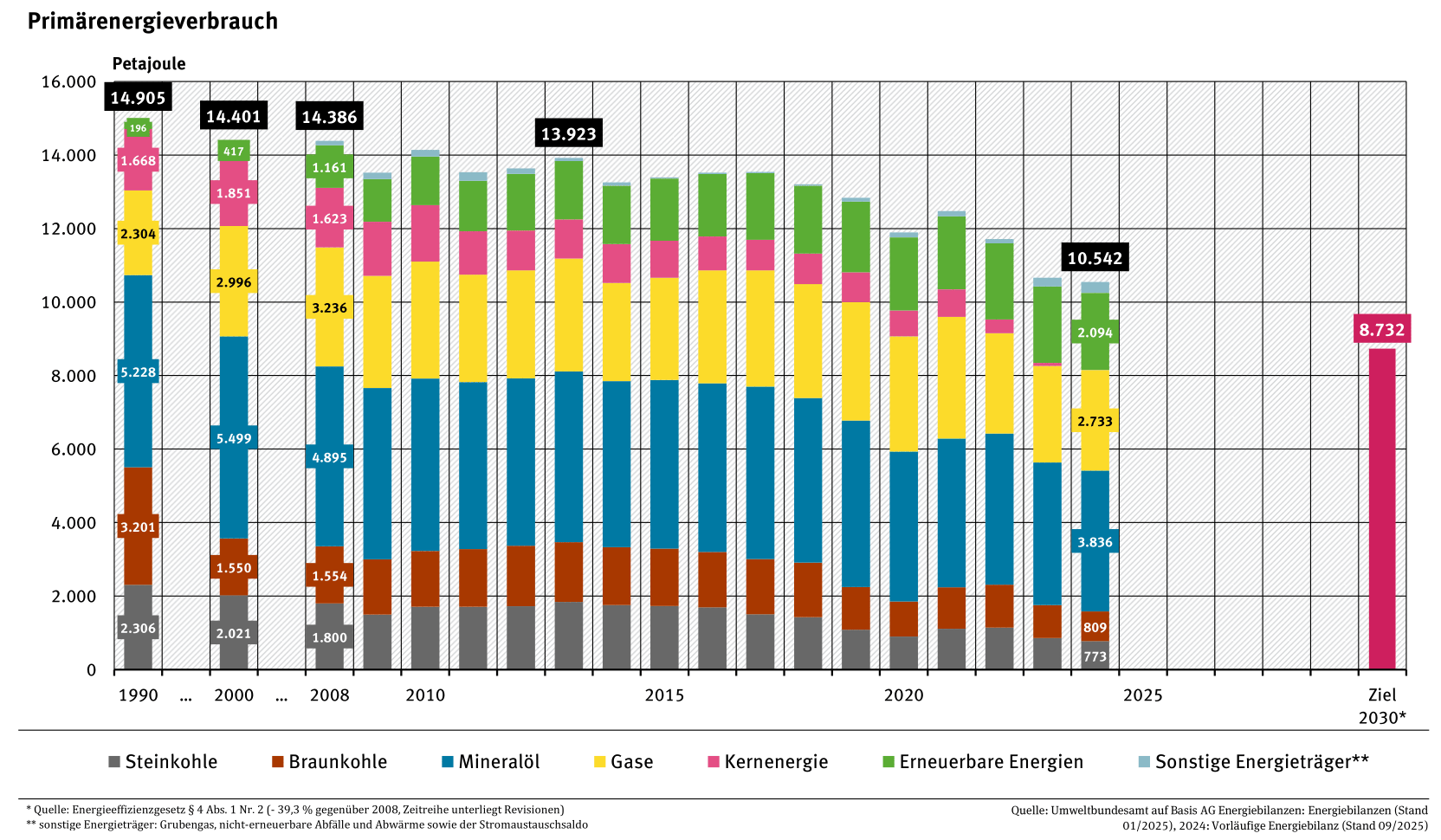 The 10,542 petajoules can be converted by dividing them by 3,600 (1 joule is one watt-second, i.e. one watt for one second, as the name "watt-hour" suggests, one watt for one hour): 2.928 TWh. The 2,094 PJ of renewable energy are therefore 582 TWh. But that's a mixture of fires and electricity from solar, wind and hydropower.
A considerable part of this is making fires with biomass. The 26,000 km² of fields for growing corn, rapeseed and sunflowers, just for burning. All the wood that is burned and drives neighbors to despair. This means that a considerable part of these 582 TWh is gross nonsense that should be stopped.
The 10,542 petajoules can be converted by dividing them by 3,600 (1 joule is one watt-second, i.e. one watt for one second, as the name "watt-hour" suggests, one watt for one hour): 2.928 TWh. The 2,094 PJ of renewable energy are therefore 582 TWh. But that's a mixture of fires and electricity from solar, wind and hydropower.
A considerable part of this is making fires with biomass. The 26,000 km² of fields for growing corn, rapeseed and sunflowers, just for burning. All the wood that is burned and drives neighbors to despair. This means that a considerable part of these 582 TWh is gross nonsense that should be stopped.